Key Takeaways
- Tax-ready books provide organized financial records for your CPA or tax preparer, but they do not prepare your tax return.
- Clean categories, reconciled accounts, and organized documents are essential for effective tax preparation.
- Monthly bookkeeping prevents last-minute scrambles by keeping records current and organized throughout the year.
- Common bookkeeping issues include mixed expenses and missing receipts, which can complicate tax preparation.
- Getting your books organized before tax season ensures a smoother process and clearer financial understanding.
Tax-ready books do not mean your bookkeeper has prepared your tax return. They also do not mean every tax question has an answer before your CPA or tax preparer reviews your situation.
Tax-ready books mean your financial records are organized, categorized, reconciled, and supported well enough that your tax preparer can use them efficiently.
In plain English, tax-ready books help answer questions like:
Did the business record all income?
Are expenses sorted into clear categories?
Do the bank, credit card, loan, and payment accounts match the books?
Can the business owner find receipts, statements, and supporting documents when needed?
The IRS explains that business records should substantiate income and expenses and clearly reflect gross income and expenses. That is the heart of tax-ready bookkeeping: your books should give your CPA or tax preparer a clear, organized picture of what happened financially during the year. (IRS)
What Tax-Ready Books Are—and What They Are Not
Tax-ready books are clean, organized financial records prepared for tax review.
They usually include categorized transactions, reconciled accounts, organized documents, and financial reports that make sense. Your bookkeeper helps organize the information. Your CPA or tax preparer uses that information, along with their tax knowledge, to prepare the return and answer tax-specific questions.
Tax-ready books are not the same as tax preparation.
A bookkeeper generally does not decide tax strategy, prepare the tax return, or give tax advice unless they also hold the proper credentials and offer that service. Instead, a bookkeeper helps make sure the financial information your tax preparer receives has structure, support, and fewer avoidable problems.
That distinction matters. Clean books help your CPA or tax preparer do their work, but they do not replace professional tax guidance.
Why Clean Categories, Reconciled Accounts, and Organized Documents Matter
At tax time, your numbers need to tell a clear story.
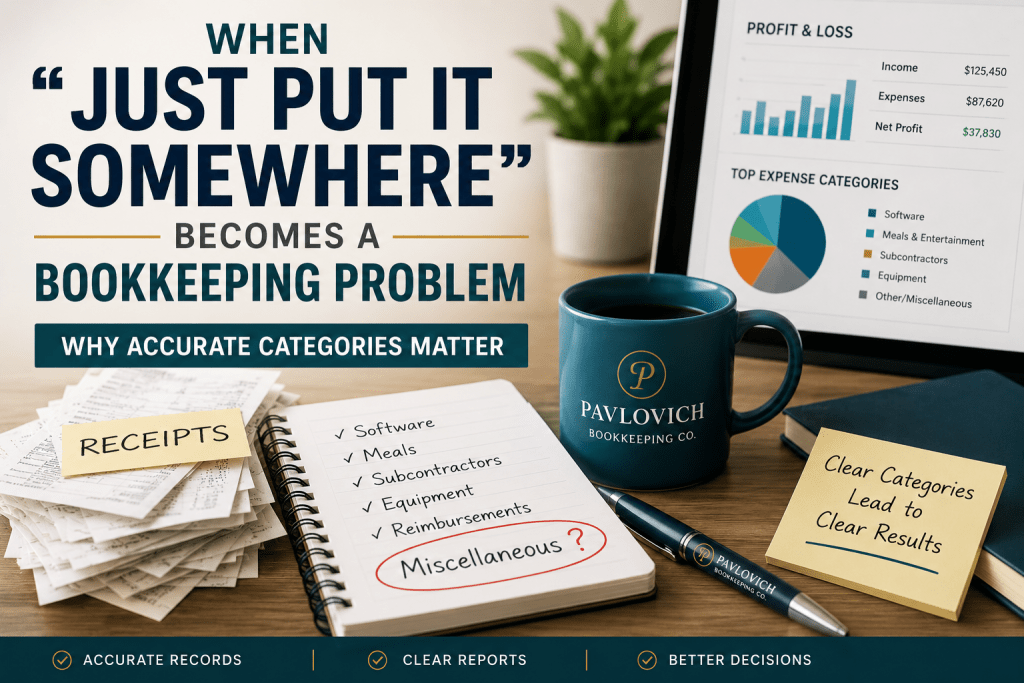
Clean categories help show where money came from and where it went. For example, office supplies, software subscriptions, contractor payments, meals, rent, insurance, and equipment should not all sit in one vague “miscellaneous” category. When categories stay too broad, your tax preparer may need to ask more questions before they can use the information.
Reconciled accounts also matter. A bank feed alone does not prove the books are correct. Reconciliation compares the books to bank, credit card, loan, and merchant account statements. This helps catch missing transactions, duplicates, incorrect balances, and payments that landed in the wrong place.
Organized documents complete the picture. Receipts, loan statements, payroll reports, asset purchases, mileage records, 1099 information, and year-end statements may all support the numbers in your books. The IRS also notes in its small business recordkeeping guidance that business owners can choose a recordkeeping system suited to their business, but that system should clearly show income and expenses. (IRS)
What Your CPA or Tax Preparer Usually Needs From Your Books
Every business differs, but many CPAs and tax preparers ask for the same core items.
They may need a profit and loss statement, balance sheet, general ledger, reconciled bank and credit card accounts, payroll reports, loan details, asset purchase information, owner contribution and draw details, and copies of important tax forms.
They may also ask about unusual transactions. For example, they may want more detail on large purchases, personal payments, reimbursements, transfers between accounts, new loans, equipment purchases, or payments to contractors.
Good bookkeeping makes those questions easier to answer. Instead of searching through emails, bank accounts, shoeboxes, and old statements, you can work from organized records and clear reports.
Common Issues That Make Books Harder to Use at Tax Time
Many small business owners fall behind because they focus on customers, jobs, and daily operations. The problem usually appears at tax time, when months of small bookkeeping issues turn into one large cleanup project.
Common issues include:
Mixed business and personal expenses
Unreconciled bank or credit card accounts
Duplicate transactions from bank feeds
Transfers categorized as income or expenses
Loan payments recorded incorrectly
Owner draws treated inconsistently
Merchant deposits recorded without separating fees or refunds
Too many transactions left as “uncategorized”
These issues do not always mean the business owner did something wrong. Often, they mean the bookkeeping system needs more structure and regular attention.
How Monthly Bookkeeping Helps Avoid Year-End Scrambling
Monthly bookkeeping helps prevent tax-time stress because it spreads the work throughout the year.
Instead of trying to organize twelve months of transactions at once, monthly bookkeeping keeps the books current. Each month, transactions get categorized, accounts get reconciled, questions get addressed, and reports get reviewed.
This routine helps business owners catch problems earlier. A missing statement, incorrect category, duplicate transaction, or unexplained bank balance becomes much easier to fix when it happened last month instead of last year.
Monthly bookkeeping also gives your CPA or tax preparer better information. When the books stay current, tax season does not start with a long cleanup list. It starts with organized records that your tax professional can review more efficiently.
When Catch-Up Bookkeeping May Be Needed
Catch-up bookkeeping may help if your books have fallen behind, contain many uncategorized transactions, or no longer match your bank and credit card statements.
A catch-up project usually focuses on bringing past records up to date. That may include reviewing old transactions, reconciling accounts, organizing missing details, cleaning up categories, and preparing reports that reflect the completed period.
Catch-up bookkeeping can also help when a business owner has used QuickBooks inconsistently or relied only on bank feeds without regular review. QuickBooks can be a useful tool, but it still needs correct setup, clean categories, and ongoing attention.
Once catch-up work brings the books current, monthly bookkeeping can help keep them organized going forward.
Tax-Ready Books Give Your Tax Preparer a Better Starting Point
Tax season feels harder when your books do not clearly show what happened during the year.
Tax-ready books give your CPA or tax preparer a better starting point. They help organize income, expenses, accounts, and supporting records so your tax professional can focus on tax preparation instead of sorting through incomplete bookkeeping.
The IRS Publication 583 covers recordkeeping for small businesses and explains that good records can help monitor business progress, prepare financial statements, identify income sources, track deductible expenses, and support items reported on tax returns. (IRS)
For small business owners, that means clean books serve more than one purpose. They help at tax time, but they also help you understand where your business stands throughout the year.
Get Your Books Organized Before Tax Season
Tax-ready books do not happen by accident. They come from consistent categories, reconciled accounts, organized documents, and regular bookkeeping habits.
Pavlovich Bookkeeping Co. helps small business owners organize their records, clean up past transactions, maintain monthly bookkeeping, and prepare clearer financial reports for their CPA or tax preparer.
If your books feel messy, behind, or difficult to trust, this is a good time to get them organized before tax season. Schedule a consultation to talk through where your books stand and what kind of support may help.