Key Takeaways
- Understanding inventory vs supplies is crucial for accurate bookkeeping and financial reporting.
- Different purchases serve various purposes: inventory is for resale, direct job materials support projects, and operating supplies assist daily operations.
- Accurate categorization enables better analysis of profit margins and operational costs, enhancing business decision-making.
- Mixed receipts complicate financial clarity; businesses should record purchases in appropriate categories for clearer reporting.
- Regular reviews of categorization and documentation help maintain accurate financial records and support tax readiness.
A hardware-store receipt, warehouse order, or online purchase may contain several items that look like “supplies.” However, those items may serve very different purposes in your business, which is why understanding inventory vs supplies is important.
Some purchases become products you sell. Others go directly into customer work. Certain items support day-to-day operations, while larger tools and equipment may require separate treatment.
Placing every purchase into one broad supplies category may save a few minutes during bookkeeping. Unfortunately, it can also make your financial reports less useful, hide changes in job costs, and create more questions at tax time.
Clear bookkeeping does not require dozens of complicated categories. Instead, your records should separate purchases in a way that reflects how your business operates and helps you understand where your money goes.
What Is the Difference Between Inventory, Materials, and Supplies?
The difference usually comes down to how the business uses the item.
| Purchase type | How the business uses it | Common examples |
|---|---|---|
| Inventory | Held for resale or used to produce goods for sale | Retail products, raw materials, components, finished goods |
| Direct job materials | Used for a specific customer job or project | Lumber, flooring, repair parts, fixtures, fabric |
| Operating or shop supplies | Used across the business rather than for one specific job | Gloves, rags, blades, cleaning products, small hardware |
| Office supplies | Used for administration | Paper, folders, postage, pens, printer supplies |
| Tools and equipment | Used repeatedly to perform work or operate the business | Drills, computers, machinery, larger tools |
The IRS describes inventory as items a business buys and resells to customers. For manufacturers and producers, inventory can also include raw materials or parts purchased to create finished products. (IRS)
That definition provides a useful starting point, but a business may still need professional guidance when deciding how a purchase should appear in its accounting records or on its tax return. The correct treatment can depend on the item, its use, the business’s accounting method, and other facts.
Why Do These Purchases Get Mixed Together?
Most business owners focus on completing work, serving customers, and keeping operations moving. They do not stand in a checkout line deciding whether each item belongs in inventory, direct costs, operating supplies, or equipment.
A contractor might buy lumber, screws, safety glasses, batteries, printer paper, and a new saw during one trip. Although every item appears on the same receipt, each purchase serves a different purpose.
Similar problems occur in many types of businesses:
- A repair company buys customer parts, shop towels, and diagnostic equipment from one vendor.
- A maker orders raw materials, product packaging, shipping labels, and cleaning supplies together.
- A retailer purchases resale products and display materials on the same invoice.
- A consultant buys client project materials, office supplies, and a new computer with one credit card.
Bank feeds add another challenge. A downloaded transaction usually shows the vendor and total amount, but it does not explain what the business bought. Without a receipt, invoice, or note, the bookkeeper may have no reliable way to separate the purchase.
Why Accurate Categories Improve Financial Reporting
Bookkeeping should do more than record that money left the bank account. Your records should help explain why the business spent that money and how the purchase relates to the income you earn.
Separating inventory, direct materials, and general supplies can make several parts of your financial reporting more meaningful.
You can understand gross profit more clearly
Gross profit shows what remains after subtracting the direct costs associated with the products or services you sold.
Suppose a contractor earns $20,000 from several projects and spends $7,000 on materials used for those jobs. Separating the materials from office and operating expenses helps the contractor see how much the work generated before accounting for overhead.
When direct materials sit in a general supplies category, the profit and loss statement may still show total profit. However, the report may not clearly show whether project pricing adequately covers the cost of completing the work.
Product-based businesses face a similar issue. Recording merchandise purchased for resale as office supplies can distort both inventory records and gross-profit reporting.
You can compare jobs, products, or periods
Useful categories create better questions.
A contractor can compare material costs from one project to another. A maker can review whether the cost of raw materials has increased. Meanwhile, a retailer can monitor how much money remains tied up in products held for sale.
Monthly comparisons may also reveal important changes:
- Material costs increased faster than sales.
- A particular type of job regularly uses more supplies than expected.
- Product margins have narrowed.
- General shop spending has grown without a corresponding increase in revenue.
- Inventory purchases have reduced available cash.
These insights help owners adjust estimates, review pricing, control purchasing, and plan ahead.
You can understand cash flow more accurately
Profit and cash do not always move together.
A business may spend cash to buy products that it has not sold yet. Another company may purchase materials weeks before receiving payment from a customer. Although those purchases reduce the bank balance immediately, their relationship to income may unfold over time.
Clear records help explain why a profitable business might still feel short on cash. They also help owners identify how much money goes toward inventory, customer work, overhead, and equipment.
Inventory Is Not the Same as General Supplies
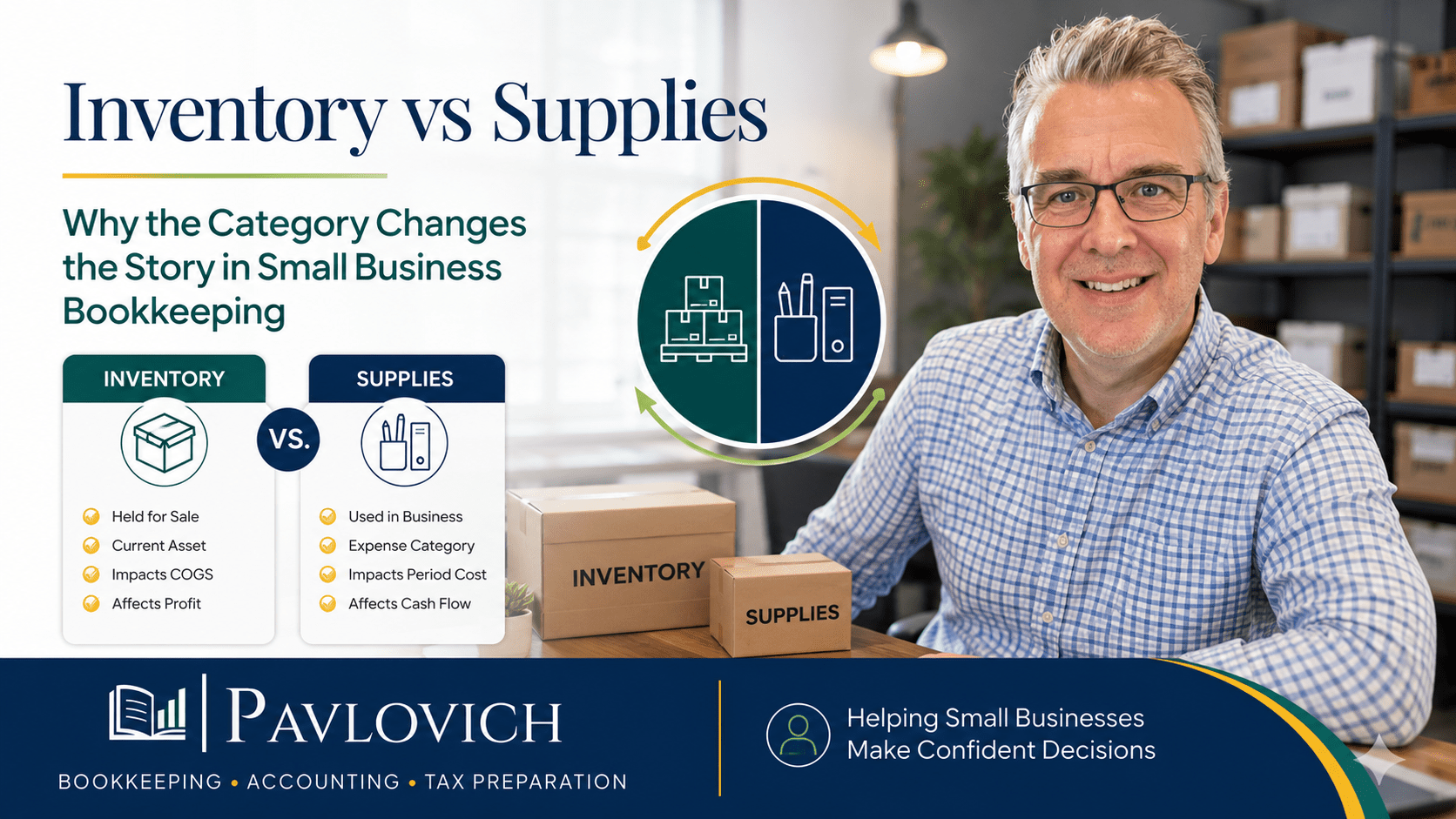
Inventory usually connects directly to products the business intends to sell.
Examples include:
- Merchandise purchased by a retailer
- Products held by an online seller
- Raw materials used by a manufacturer
- Components assembled into finished goods
- Products created and stored for future sale
Inventory may remain on the balance sheet until the business sells or otherwise accounts for it under the applicable method. Therefore, inventory activity can affect both the balance sheet and the calculation of cost of goods sold.
Tax rules also provide certain options for qualifying small businesses, so owners should not assume that every business must handle inventory in exactly the same way. A tax professional can determine which method applies to a specific situation.
From a bookkeeping perspective, the records should clearly identify what the business bought, how much it cost, and whether the items remain on hand. The IRS recommends keeping supporting documents that establish both the amount paid and the fact that the purchase related to inventory. (IRS)
Direct Job Materials Connect to Customer Work
Direct job materials include purchases used for a particular customer, project, or service.
Common examples include:
- Lumber for a remodeling project
- Replacement parts for a repair
- Flooring installed for a customer
- Fabric used to create a custom order
- Fixtures or hardware purchased for an installation
- Materials billed as part of a client project
Tracking these costs separately can help a business understand project profitability.
For example, a contractor may quote $8,000 for a project and spend $3,200 on materials. When the bookkeeping system connects those costs to the job, the owner can compare the estimate with the actual result.
Without that separation, the owner may know that the business earned money overall but remain uncertain about which projects performed well.
Not every business needs advanced job-costing software. Even a consistent direct-materials category, supported by customer or project notes, can improve reporting.
Operating Supplies Support the Business as a Whole
Operating or shop supplies help employees and owners perform their work, but they do not always belong to one customer project.
Examples may include:
- Cleaning products
- Work gloves
- Rags
- Sandpaper
- Drill bits or blades
- Small hardware used across several jobs
- Safety materials
- Tape, adhesives, and fasteners
- General packaging materials
These costs still affect profitability. However, they often represent overhead rather than a direct cost assigned to one project.
Separating operating supplies from customer materials can help answer two different questions:
- How much did it cost to complete the work?
- How much did it cost to keep the business running?
Both questions matter, but one broad supplies category may not answer either one clearly.
Office Supplies Belong to Administrative Operations
Office supplies support the administrative side of the business.
Typical purchases include paper, folders, postage, pens, envelopes, labels, and basic printer supplies. Although these items help the business operate, they usually do not become part of a product or customer job.
Mixing office purchases with production materials can make reports harder to interpret. An owner reviewing a large supplies balance may not know whether the increase came from more customer work, higher material prices, or added administrative spending.
A separate office-supplies category provides useful clarity without making the chart of accounts overly complicated.
Tools and Equipment Need a Closer Look
Tools and equipment require more care because they may not belong in an ordinary supplies category.
A low-cost item used up quickly may receive different treatment from a computer, machine, vehicle accessory, or substantial tool that the business expects to use for several years. Tax rules may require some purchases to receive capital-asset or depreciation treatment rather than an immediate expense.
Because the correct treatment depends on the facts, owners should flag significant purchases for review rather than choosing a category based only on the vendor.
Helpful documentation may include:
- The detailed receipt or invoice
- A description of the item
- The date the business began using it
- Its business purpose
- The customer or location associated with the purchase
- Notes about whether the item replaced existing equipment
Pavlovich Bookkeeping & Accounting can organize these transactions and provide clear records. However, a CPA or qualified tax professional may need to determine the appropriate tax treatment for substantial purchases or complex situations.
Mixed Receipts Need More Than One Category
One receipt may contain inventory, job materials, shop supplies, office products, and equipment. Recording the entire total in one category can hide useful information.
Consider a $650 hardware-store purchase containing:
- $250 of flooring for a customer project
- $80 of fasteners used across several jobs
- $20 of cleaning products
- $300 for a new power tool
The vendor name does not tell the financial story. Splitting the transaction allows the books to reflect how the business used each part of the purchase.
Detailed receipts make this process much easier. When a receipt becomes difficult to read, a short note can preserve the business purpose while the purchase remains fresh in the owner’s memory.
Useful notes might include:
- “Materials for Wilson bathroom project”
- “General shop supplies”
- “Replacement drill for field work”
- “Products purchased for resale”
- “Office storage shelves”
The IRS states that receipts, invoices, paid bills, and other supporting documents provide the information businesses need to record transactions and support entries in their books and tax returns. (IRS)
How QuickBooks Categories Affect Your Reports
The chart of accounts determines how QuickBooks organizes transactions and where amounts appear on financial reports.
QuickBooks uses account types to separate balance-sheet activity from income, expenses, and cost of goods sold. Detail types provide another layer of organization, although they do not necessarily change the accounting treatment by themselves. (QuickBooks)
A practical chart of accounts might include categories such as:
- Inventory
- Direct Job Materials
- Product or Resale Purchases
- Shop or Operating Supplies
- Office Supplies
- Tools and Small Equipment
- Equipment or Fixed Assets
The exact structure should match the business.
A contractor may need direct materials and project tracking. An online seller may need stronger inventory records. A repair business may need to separate customer parts from general shop supplies.
More categories do not automatically create better reports. Too many similar accounts can lead to inconsistent bookkeeping and make monthly review more difficult.
The goal is to create enough separation to understand the business without turning every transaction into a complicated decision.
What Records Should Small Business Owners Keep?
Organized documentation makes categorization easier and helps preserve tax-ready records.
For inventory, materials, supplies, and equipment, consider keeping:
- Itemized receipts
- Vendor invoices
- Purchase orders
- Customer or project notes
- Product lists or inventory counts
- Estimates that identify materials
- Customer invoices showing billable items
- Photos of unclear or fading receipts
- Notes explaining mixed purchases
- Information about significant tools or equipment
Store the documentation with the transaction whenever your bookkeeping software allows it. Consistent records reduce guesswork and help your bookkeeper complete monthly work while the information remains current.
What Should You Review Each Month?
A monthly review can keep small categorization problems from growing into larger reporting issues.
Ask these questions:
- Did the business purchase products for resale?
- Did any purchases relate directly to a customer job?
- Do mixed receipts need to be divided?
- Did the business buy any significant tools or equipment?
- Are material costs increasing?
- Do inventory records match what the business has on hand?
- Are transactions supported by receipts, invoices, or clear notes?
- Do the financial reports separate direct costs from overhead?
Regular review improves more than bookkeeping accuracy. It also gives owners a clearer view of margins, purchasing patterns, cash demands, and operating costs.
Clear Categories Help You Make Better Business Decisions
The difference between inventory, materials, and supplies is not simply an accounting detail. Each category explains a different part of the business.
Inventory shows money connected to products held for sale. Direct materials help measure the cost of customer work. Operating and office supplies reveal overhead, while tools and equipment represent resources the business may use over a longer period.
When those purchases land in appropriate categories, financial reports become easier to understand. Owners can review profitability, compare costs, prepare tax-ready records, and discuss their numbers more effectively with their tax professional.
Pavlovich Bookkeeping & Accounting helps small business owners organize transactions, improve QuickBooks records, and turn monthly bookkeeping into meaningful financial information. Schedule a consultation to discuss bookkeeping and accounting support that reflects how your business actually works.