
Key Takeaways
- Organized financial records simplify small business tax preparation and provide clarity throughout the year.
- Effective income and expense tracking is crucial for understanding business activities and ensuring proper reporting to the IRS.
- Regular reconciliation of accounts helps maintain accurate records, reducing complications during tax season.
- Monthly bookkeeping practices create efficient workflows and minimize stress during tax preparation.
- Small business tax preparation relies on well-structured bookkeeping and accounting processes for best results.
Small business tax preparation becomes much easier when your financial records already tell a clear story.
Instead of sorting through months of deposits, receipts, payment apps, credit card charges, transfers, and unanswered bookkeeping questions at the last minute, you can begin tax preparation with organized information. Your books should help show what the business earned, what it spent, what it owns, what it owes, and which transactions still need attention.
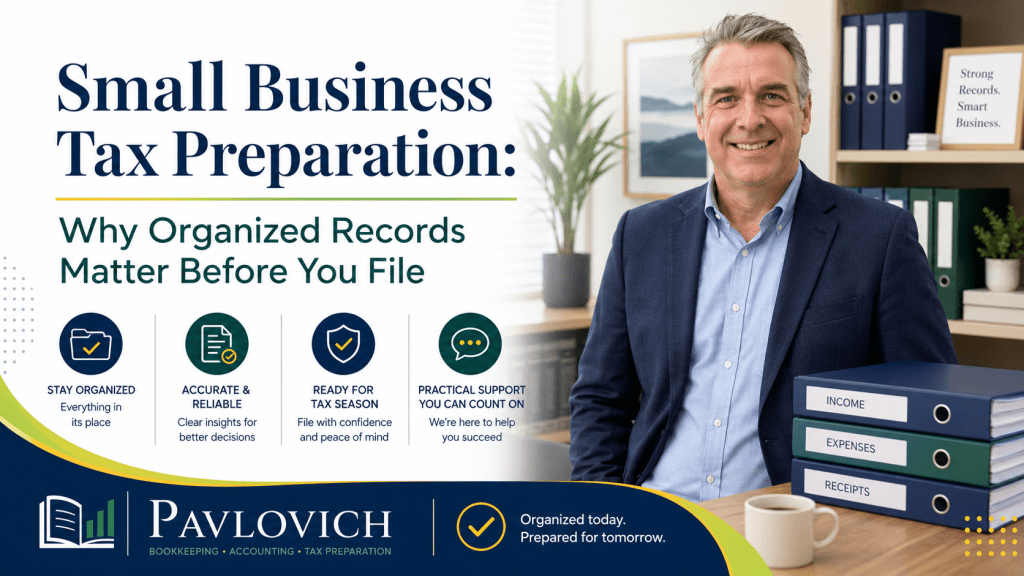
That matters for sole proprietors, small LLCs, contractors, consultants, service businesses, and other small business owners. Tax preparation does not begin with a tax form. It begins with the financial records behind the numbers on that form.
The IRS allows businesses to use a recordkeeping system that fits their operations, but the records must clearly show income and expenses and support the amounts reported on a tax return. (IRS)
Organized bookkeeping creates that foundation. However, the value goes beyond filing a return. Current books, useful financial reports, and practical accounting support can also help you understand where your business stands throughout the year.
Small Business Tax Preparation Starts With Complete Income Records
Income tracking is one of the first places tax preparation can become complicated.
Many small businesses receive money through several channels. A contractor might receive checks and ACH payments. A consultant may collect payments through a credit card processor. A local service business could receive cash, checks, online payments, and deposits from third-party platforms.
Looking at one bank account or one tax form may not show the full picture.
Your bookkeeping should help connect the different ways money enters the business. That may include:
- Customer invoices
- Sales records
- Bank deposits
- Payment processor reports
- Forms 1099
- Cash receipts
- Refunds and credits
- Transfers between accounts
Not every deposit automatically represents business income. For example, an owner contribution, loan proceeds, transfer between accounts, or reimbursement may require different treatment.
At the same time, receiving a tax form does not replace your own records. Your books provide the context needed to understand what happened throughout the year.
The IRS emphasizes that a business recordkeeping system should summarize transactions and show gross income, deductions, and credits. (IRS)
When your income records stay organized, your tax preparer can spend less time reconstructing the year and more time reviewing the information that actually matters.
Organized Expense Records Help Explain What the Business Spent
Knowing that money left your bank account does not always explain why the business spent it.
A charge may represent office supplies, equipment, software, materials, insurance, advertising, professional services, or another business cost. Some purchases may contain both business and personal items. Others may require more information before anyone can determine how they belong in the books.
Good expense records help answer practical questions:
- What did the business purchase?
- When did the purchase occur?
- Who received the payment?
- What was the business purpose?
- Is there a receipt, invoice, statement, or other supporting document?
- Did the purchase include both business and personal items?
- Was the payment an expense, loan payment, asset purchase, owner transaction, or something else?
The IRS explains that business transactions create supporting documents and that records generally need to be kept long enough to substantiate income and deductions reported on a return. (IRS)
A bank statement can show that a payment happened. It may not explain the business purpose behind the payment.
That is why organized bookkeeping should include more than importing transactions into software. Clear descriptions, supporting documents, consistent categories, and regular review all help create more useful records.
Reconciled Accounts Create a Stronger Starting Point
Bookkeeping software can automatically import transactions from connected bank and credit card accounts. However, imported activity alone does not mean the books are complete or accurate.
Reconciliation compares the transactions in your bookkeeping records with the activity shown on the actual financial statement.
For example, a monthly reconciliation may reveal:
- Duplicate transactions
- Missing transactions
- Deleted entries
- Payments recorded in the wrong account
- Transfers categorized as income or expenses
- Uncleared checks
- Incorrect beginning balances
- Credit card payments recorded twice
Without reconciliation, a profit and loss statement may look polished while still relying on incomplete information.
Regular reconciliations help create a more dependable foundation for financial reporting and tax preparation. They also give business owners an opportunity to identify problems before several months pass.
This is one reason monthly bookkeeping matters. When records remain current, your year-end work becomes a review process instead of a reconstruction project.
Tax-Ready Books Are More Than a List of Transactions
Tax-ready books should help explain the financial activity of the business.
That does not mean every question disappears. In fact, a good tax preparer will still ask questions and request supporting information when necessary.
The difference is that organized books lead to better questions.
Instead of spending most of the tax preparation process identifying mystery deposits and unexplained charges, the conversation can focus on issues such as:
- Whether all income sources were included
- Whether tax documents agree with the underlying records
- Whether large or unusual transactions need additional review
- Whether contractor and payroll records are complete
- Whether asset purchases require special attention
- Whether the business changed significantly during the year
- Whether the tax situation has become complex enough to require a CPA or another specialized tax professional
Tax-ready bookkeeping does not replace professional judgment. It gives the person preparing the return better information to work with.
Sole Proprietors and Small LLCs Still Need Organized Books
Small businesses sometimes assume formal bookkeeping matters only for larger companies.
In reality, a sole proprietor or small LLC may have many of the same recordkeeping challenges as a larger business.
Consider a self-employed contractor who receives customer payments through checks, ACH transfers, and a payment app. The business owner also uses a credit card for materials, pays subcontractors, makes equipment purchases, drives to job sites, and occasionally pays a business expense with a personal card.
By tax time, several questions may need answers:
- Were all sources of income recorded?
- Were transfers separated from customer payments?
- Were personal and business purchases kept separate?
- Were contractor payments tracked clearly?
- Were reimbursements recorded properly?
- Are major purchases easy to identify?
- Do the bookkeeping records agree with the financial accounts?
A small business does not need a complicated accounting system simply because many transactions occurred. It does need an organized one.
The goal is to create records that accurately reflect the business and provide enough detail for financial reporting and tax preparation.
Catch-Up Bookkeeping May Be the First Step When Records Are Behind
Sometimes tax preparation reveals a bookkeeping problem before it reveals a tax problem.
Perhaps several months of transactions remain uncategorized. Maybe bank accounts were never reconciled. Personal and business expenses may appear together, or QuickBooks may contain years of bank feed activity that no one fully reviewed.
In those situations, catch-up bookkeeping or bookkeeping cleanup may need to come before tax preparation.
The process may involve:
- Reviewing existing bookkeeping records
- Bringing missing months up to date
- Categorizing transactions
- Reconciling bank and credit card accounts
- Identifying unclear deposits and payments
- Correcting obvious bookkeeping errors
- Organizing records for financial reporting and tax preparation
The exact work depends on the condition of the books.
A business that is simply three months behind may need catch-up bookkeeping. Another business may have current transactions but inaccurate balances, duplicate entries, or years of inconsistent categorization that require a more involved cleanup.
The important point is to start with the actual condition of the records rather than assuming tax preparation alone will solve the problem.
What Should You Organize Before Small Business Tax Preparation?
The records you need depend on your business and tax situation. However, many small business owners should expect to gather information from several areas.
Income Records
Gather records that help explain how the business received money, including:
- Sales reports
- Customer invoices
- Bank deposits
- Payment processor reports
- Forms 1099
- Records of cash payments
- Refund and credit information
Compare these records with your bookkeeping rather than relying on one source alone.
Bank and Credit Card Records
Collect complete statements for business accounts.
These may include:
- Checking accounts
- Savings accounts
- Credit cards
- Lines of credit
- Loans
- Payment processors
Complete statements are especially important when accounts need reconciliation.
Expense Documentation
Organize supporting information such as:
- Receipts
- Vendor invoices
- Bills
- Subscription records
- Equipment purchase documents
- Professional service invoices
- Insurance records
- Vehicle or mileage records when applicable
A consistent document-storage system makes this work much easier.
Contractor and Payroll Information
Depending on the business, you may also need:
- Contractor payment records
- W-9 information
- Payroll reports
- Payroll tax records
- Employee-related records
Employment tax records may have different retention requirements from other business records, so business owners should follow the applicable IRS guidance and consult their tax professional when necessary. (IRS)
Loan and Asset Information
Loan payments often include more than one accounting component. Likewise, a major equipment purchase may need different treatment from an ordinary operating expense.
Keep records that show:
- Loan balances
- Interest paid
- New financing
- Equipment purchases
- Vehicle purchases
- Property information
- Major improvements
These items may require additional review during tax preparation.
Organized Books Make Financial Reports More Useful
Tax preparation is an important reason to maintain good records, but it should not be the only reason.
When bookkeeping stays current, your financial reports can help you understand the business throughout the year.
A profit and loss statement can help you review income and expenses over a period of time. A balance sheet can show assets, liabilities, and equity at a particular point in time. Cash flow information can help explain why the amount of cash available does not always move in the same direction as profit.
The SBA identifies financial statements and accounting information as important tools for understanding business performance and making informed decisions. (Small Business Administration)
Useful reports can help a business owner ask better questions:
- Is revenue increasing while profit is shrinking?
- Which expenses have changed?
- Does the business have enough cash for upcoming obligations?
- Are customers taking longer to pay?
- Are debts increasing?
- Do the reports match what the owner sees happening in the business?
Bookkeeping creates the underlying records. Accounting support and financial reporting help turn those records into information you can actually use.
That is the broader goal: not simply recording what already happened, but helping you understand what the numbers are telling you.
Monthly Bookkeeping Can Reduce the Year-End Rush
Waiting until tax season to review an entire year of financial activity creates unnecessary pressure.
Details become harder to remember. Receipts disappear. Employees change. Vendors close accounts. Business owners forget why certain transfers occurred or what an unfamiliar charge represented.
A monthly bookkeeping routine gives you more opportunities to resolve those questions while the information remains fresh.
Throughout the year, you can:
- Review income and expenses
- Reconcile financial accounts
- Organize supporting documents
- Identify unclear transactions
- Correct bookkeeping errors
- Review financial reports
- Keep records ready for tax preparation
Good recordkeeping can also support more than tax compliance. The IRS notes that maintaining records helps business owners monitor the progress of the business, prepare financial statements, identify income sources, track deductible expenses, and prepare tax returns. (IRS)
Tax season should not be the first time you try to understand what happened financially during the year.
Small Business Tax Preparation Works Better When Bookkeeping and Accounting Work Together
Bookkeeping, accounting support, financial reporting, and tax preparation serve different purposes, but they work best when the information flows from one stage to the next.
Organized bookkeeping creates dependable records.
Reconciliations help confirm that those records agree with financial accounts.
Financial reporting organizes the information into a clearer picture of the business.
Accounting support helps the owner understand that picture.
Tax preparation then uses organized, reviewed information to prepare the appropriate return.
For many small business owners, that connected process creates a better experience than treating bookkeeping and taxes as unrelated once-a-year tasks.
Pavlovich Bookkeeping & Accounting works with small business owners who need organized records, practical accounting support, clearer financial reporting, and tax-ready books. Our small business tax preparation services are intended for sole proprietors, small LLCs, and similar straightforward small businesses that fit within our scope.
We are not a CPA firm, and some businesses need a CPA or specialized tax professional for complex tax situations, audits, advanced tax matters, or other services outside our scope. When a situation requires a different level of expertise, the right next step may be working with that professional while maintaining organized bookkeeping records.
Get Your Books Organized Before You File
Small business tax preparation becomes more manageable when your records are already current, organized, and ready for review.
You should not have to begin tax season by reconstructing an entire year from bank statements and memory. A consistent bookkeeping process can help you maintain clearer records, prepare more useful financial reports, and give your tax preparer better information.
Pavlovich Bookkeeping & Accounting helps small business owners make sense of their numbers through monthly bookkeeping, catch-up bookkeeping, bookkeeping cleanup, accounting support, financial reporting, QuickBooks support, tax-ready financial records, and tax preparation for qualifying clients.
If your books are behind, difficult to understand, or not ready for tax preparation, schedule a consultation to discuss your current records and determine the best place to begin.