
Key Takeaways
- Organizing your records before a tax appointment ensures a smoother process and helps avoid last-minute searches.
- A personal tax documents checklist lets you keep track of what you have and what you still need before meeting your preparer.
- Gather personal information, income documents, deduction records, and health insurance information as part of your tax documents checklist.
- Inform your tax preparer about any major life changes, as these can impact your tax situation.
- Using organized records allows your tax preparer to create a clearer picture of your financial year, facilitating better guidance.
Tax preparation usually goes more smoothly when your records are organized before your appointment. Having a tax documents checklist can help you ensure nothing is missed during this process. Instead of searching through email accounts, bank statements, and paperwork at the last minute, you can gather the information your tax preparer may need one category at a time.
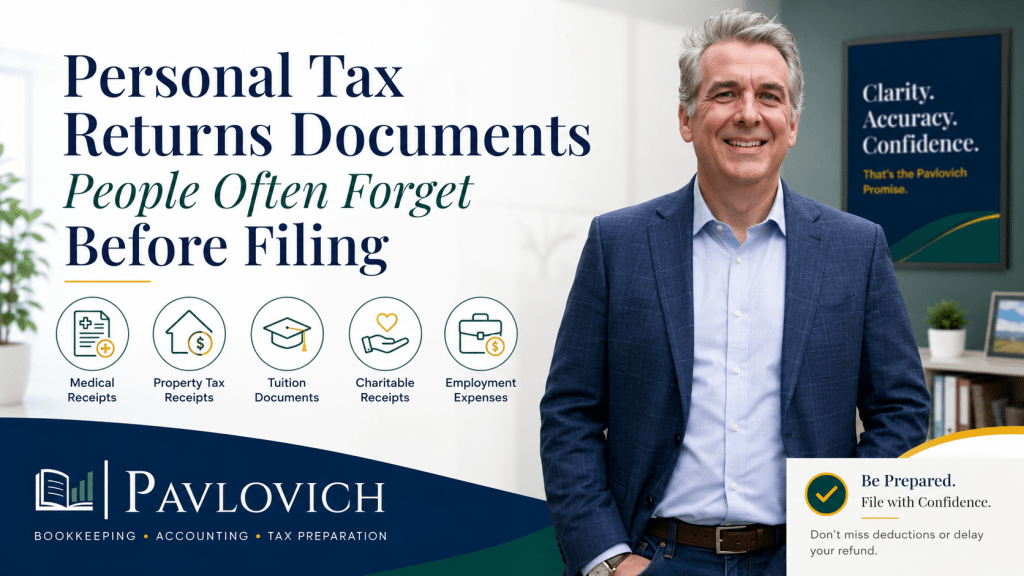
A personal tax preparation documents checklist helps you see what you already have, what may still be missing, and which questions you should raise during your appointment. You do not need to understand every tax rule before you meet with a preparer. However, complete and accurate records give your preparer better information to work with.
The IRS recommends gathering personal information, income documents, records that may support deductions or credits, and other relevant tax records before filing. Many tax documents may also be available through employer, bank, brokerage, retirement, school, or payment-platform accounts. (IRS)
Not every document in this checklist will apply to every taxpayer. Your needs depend on your income, household, investments, property, business activity, and other circumstances.
Start With Your Personal and Household Information
Begin with the basic information that identifies you and the people who may appear on your tax return.
Gather:
- Government-issued photo identification
- Social Security numbers or ITINs for you, your spouse, and dependents
- Dates of birth for household members who may appear on the return
- A copy of your previous tax return, if available
- Any IRS or state tax notices you received
- Your current Identity Protection PIN, if applicable
- Bank routing and account information for direct deposit or electronic payment
The IRS also recommends having your current address, prior filing information when applicable, and your IP PIN available before filing. (IRS)
A previous tax return can provide useful background, but it should not replace your current-year records. Your income, dependents, address, filing situation, and other details may have changed.
Bring complete copies of any IRS or state notices rather than relying on a partial screenshot. The full notice may contain dates, tax periods, identification numbers, payment information, and instructions that help your preparer understand the issue.
Gather All of Your Income Documents
Income can come from more places than a regular paycheck. Before your appointment, think through every source of money you received during the year.
Common income documents include:
- Form W-2 from each employer
- Form 1099-NEC for certain independent contractor or freelance income
- Form 1099-MISC for certain types of miscellaneous income
- Form 1099-K for certain payments processed through payment apps, card processors, or online marketplaces
- Form 1099-INT for interest income
- Form 1099-DIV for dividend income
- Form 1099-B for certain investment transactions
- Form 1099-R for retirement plan or IRA distributions
- Form SSA-1099 for Social Security benefits
- Form 1099-G for certain government payments
- Schedule K-1 from a partnership, S corporation, estate, or trust
- Other records of income that may not appear on a standard tax form
The IRS advises taxpayers to gather W-2s, 1099s, and other records showing income before filing. That can include retirement distributions, interest, dividends, unemployment compensation, gig-economy income, and other income records. (IRS)
Do not assume every tax form will arrive in the mail. Employers, financial institutions, schools, retirement plans, and other organizations may provide forms electronically.
Before your appointment, review the online accounts you used during the year. A missing form can delay preparation or require additional follow-up.
Do Not Rely on a Tax Form to Tell the Whole Story
Tax forms are important, but they do not always provide all the context your preparer may need.
For example, someone who received payments through a payment app or online marketplace may receive a Form 1099-K. That form is one piece of the recordkeeping process. Your own records may still be necessary to explain what the payments represented and how they relate to other income records.
Likewise, investment activity may involve more than one document. A brokerage account could include interest, dividends, sales, and other transactions.
The goal is not simply to collect forms. It is to give your preparer an organized picture of what happened during the year.
Gather Records That May Relate to Deductions or Credits
Some tax benefits depend on details that an income form will not show. Receipts, statements, provider information, and other supporting records may help your preparer determine what applies to your situation.
Depending on your circumstances, gather records such as:
- Mortgage interest statements, including Form 1098
- Property tax records
- Charitable contribution records
- Medical and dental expense records
- Health Savings Account documents
- Child and dependent care provider information
- Education forms, including Form 1098-T
- Student loan interest statements
- Retirement contribution records
- Adoption-related records
- Records related to qualifying energy improvements
- Records related to qualifying vehicle purchases
- Other documents connected to potential deductions or credits
You do not need to decide on your own which tax treatment applies before your appointment. Bring the relevant records and let your tax preparer review them in the context of your complete return.
Good records matter because a payment alone may not explain its purpose. A bank statement might show that money left your account, but a receipt, invoice, statement, or other supporting document often provides the details needed to understand the transaction.
The IRS recommends keeping records that support income, deductions, and credits reported on a tax return. (IRS)
Bring Child and Dependent Care Information
Families who paid for qualifying care may need information about the care provider.
Gather:
- The provider’s name
- Address
- Taxpayer identification information
- The total amount paid
- Records showing when and why care was provided, when relevant
Also tell your preparer about changes involving dependents. A child starting college, a new baby, a change in custody arrangements, or support provided to another family member may affect what information your preparer needs to review.
Avoid assuming that a family member automatically qualifies as a dependent or that a particular expense automatically qualifies for a tax benefit. Bring the facts and supporting records so your preparer can evaluate the situation.
Gather Education-Related Documents
Education can generate several different tax documents.
Depending on your situation, gather:
- Form 1098-T
- Student loan interest statements
- Scholarship or grant information
- Records of qualifying education expenses
- Information about the student and educational institution
Keep education records together instead of mixing them with general household paperwork. That makes it easier to identify which expenses relate to which student.
Do Not Forget Marketplace Health Insurance Documents
Health insurance records can matter during tax preparation, particularly when someone in the household received coverage through the Health Insurance Marketplace.
If you had Marketplace coverage, gather Form 1095-A before filing. The IRS explains that taxpayers use information from Form 1095-A to complete the required premium tax credit reconciliation and, when eligible, claim the Premium Tax Credit. (IRS)
You may receive other health coverage documents as well. Keep them with your tax records so your preparer can review the information that applies to your return.
Keep a Record of Estimated Tax Payments and Other Payments
One of the easiest things to overlook is a tax payment you made during the year.
Gather records for:
- Federal estimated tax payments
- State estimated tax payments
- Extension payments
- Online payment confirmations
- Prior-year refunds applied to the following tax year
- Payments made in response to a tax notice
- Other federal or state tax payments
For each payment, record the:
- Date
- Amount
- Tax agency
- Tax year the payment applied to
This information can be especially important for self-employed individuals, retirees, investors, and others who made payments outside regular paycheck withholding.
Do not rely entirely on memory. Payment confirmations, account records, and tax agency records provide a clearer trail.
Tell Your Preparer About Major Life Changes
Your tax documents may not explain everything that changed during the year.
Make a short list of significant events to discuss with your preparer, such as:
- Marriage
- Divorce or separation
- Birth or adoption of a child
- A dependent leaving or returning to the household
- A move
- Buying or selling a home
- Starting or leaving a job
- Starting freelance or business activity
- Retirement
- Beginning to receive Social Security
- Paying for dependent care
- Supporting an aging parent or another family member
- A child starting college
- Selling investments or other property
- Receiving an inheritance
- A significant change in income
A life event does not necessarily create a particular tax result. However, telling your preparer what changed can help identify the questions and records that deserve further review.
You do not need to know whether something is “tax-related” before mentioning it. Providing the context allows your preparer to decide what matters.
Keep Side Business and Self-Employment Records Separate
Personal tax preparation can become more complicated when you also have freelance work, gig income, rental activity, or a small business.
Keep those records separate from your household paperwork.
For a sole proprietorship, freelance activity, or similar small business, you may need records such as:
- Income summaries
- Business bank statements
- Payment processor reports
- Forms 1099-NEC, 1099-MISC, or 1099-K
- Expense records organized by category
- Receipts and invoices
- Mileage records
- Home office information, when applicable
- Equipment and other asset purchase records
- Business loan information
- Prior-year depreciation schedules, if available
- Bookkeeping reports, when available
The IRS advises business owners to keep records that document income and expenses, including items such as invoices, deposit information, receipt records, and other supporting documents. (IRS)
This is also where organized bookkeeping becomes especially valuable. A pile of bank statements may show money moving in and out, but organized financial records provide a much clearer picture of business activity.
When your books are current and your records are organized, tax preparation can begin with better information. Monthly bookkeeping can also help you understand your business throughout the year rather than treating financial records as something you only look at during tax season.
Pavlovich Bookkeeping & Accounting provides personal tax preparation and limited small business tax preparation for sole proprietors, small LLCs, and similar simple businesses. More complex business structures or specialized tax situations may require a CPA or another tax professional with the appropriate expertise.
What Should You Do If a Tax Form Is Missing?
Do not guess.
First, check the online account associated with the missing document. Employers, banks, brokerage firms, schools, lenders, retirement plans, government agencies, and payment platforms may make tax documents available electronically.
If you still cannot locate a record, contact the organization that issued it.
The IRS also provides access to certain tax records and transcripts, including wage and income information and previous tax return information. (IRS)
However, a transcript may not replace every original document or provide every detail your preparer needs. Treat it as one resource for identifying or recovering missing information rather than assuming it solves every documentation problem.
A Simple Personal Tax Preparation Documents Checklist
Before your appointment, review this checklist and gather the items that apply to you.
Personal information
- Photo identification
- Social Security numbers or ITINs
- Dates of birth
- Prior-year tax return
- IRS or state tax notices
- Current IP PIN, if applicable
- Bank information for direct deposit or payment
Income records
- W-2s
- 1099 forms
- Social Security income statements
- Retirement income statements
- Investment records
- Schedule K-1 forms
- Other income records
Household, deduction, and credit records
- Mortgage interest statement
- Property tax records
- Charitable contribution records
- Medical and dental records
- HSA documents
- Childcare provider information
- Education forms and records
- Student loan interest statements
- Retirement contribution records
- Other records related to potential deductions or credits
Health insurance records
- Form 1095-A for Marketplace coverage, if applicable
- Other relevant health coverage records
Tax payment records
- Federal estimated tax payments
- State estimated tax payments
- Extension payments
- Payment confirmations
- Prior-year refunds applied to the current tax year
Business or side-income records
- Business income records
- Forms 1099
- Bank and payment processor records
- Organized business expenses
- Receipts and invoices
- Mileage records
- Asset purchase information
- Bookkeeping reports
Other information
- Notes about major life changes
- Records related to property sales or investments
- Information about new dependents or changes in household circumstances
- Questions you want to discuss during your appointment
How to Organize Your Tax Documents Before Your Appointment
You do not need an elaborate filing system.
Start with a few simple categories:
- Personal information
- Income
- Deductions and credits
- Tax payments
- Business or side income
- Tax notices and questions
As documents arrive, place them in the correct folder or secure digital location.
Before your appointment, compare what you collected with the income sources, financial accounts, employers, and major events you remember from the year. This final review can help you notice a missing W-2, 1099, investment statement, or other record before preparation begins.
The IRS encourages taxpayers to gather all necessary records before filing because complete information can help reduce errors and the need to amend a return later. (IRS)
Organized Records Make Tax Preparation Easier to Navigate
You do not need to arrive at your tax appointment knowing every answer. You should arrive with the clearest records you can reasonably provide.
Organized tax documents help create a better starting point. Your preparer can review your income, ask more focused questions, identify information that may still be missing, and work from records that tell a more complete story.
For small business owners and self-employed individuals, that organization should not begin and end with tax season. Reliable bookkeeping, clear financial reports, and tax-ready records can help you understand where your business stands throughout the year.
Pavlovich Bookkeeping & Accounting helps individuals and qualifying small business owners approach tax preparation with an organized process and clear communication. We also provide bookkeeping and accounting support for small businesses that need better records, clearer financial information, or help getting their books ready for tax time.
Need help preparing for tax season? Schedule a consultation to discuss your personal tax preparation, small business tax preparation, or tax-ready bookkeeping needs.