
Key Takeaways
- TikTok creator tax deductions can be confusing due to the blend of business and personal expenses.
- To qualify, expenses must connect clearly to your creator business and you need organized records.
- The IRS distinguishes between a hobby and a business, affecting what expenses can be deducted.
- Creators should track mixed-use equipment carefully to determine deductible percentages and maintain clear records.
- Clean bookkeeping simplifies tax preparation and ensures that all business-related income and expenses are accurately reported.
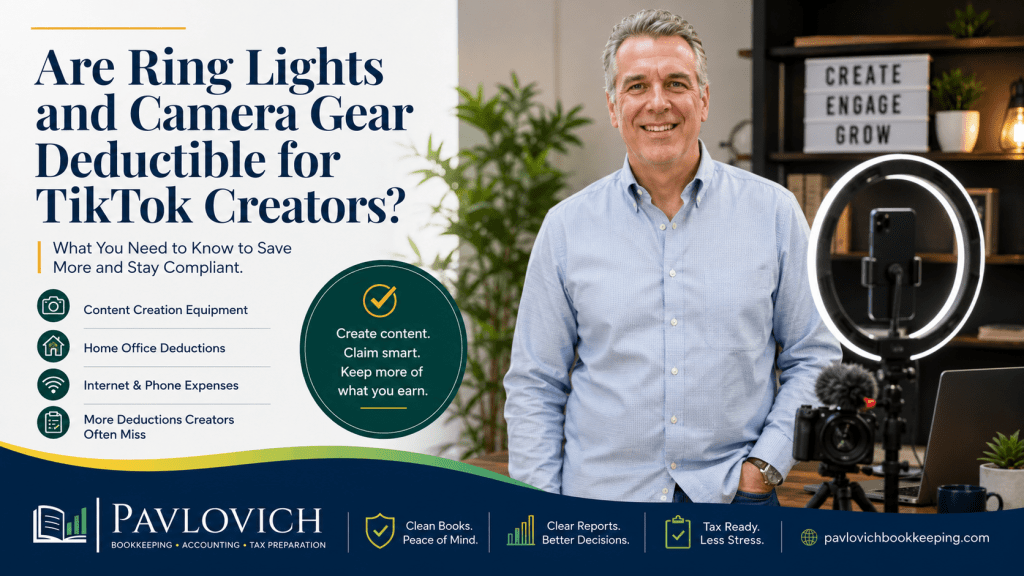
TikTok creator tax deductions can feel confusing because content often blends business, personal life, and creative work. A ring light may help you film paid brand content, but the same camera may also take family photos. A phone may record sponsored videos, answer business emails, and stream shows after work.
That overlap matters.
If you earn income from TikTok, Instagram, YouTube, affiliate links, brand partnerships, digital products, or similar creator work, some equipment and content-related expenses may qualify as business expenses. However, the expense must connect clearly to your business, and you need organized records to support it.
The Main Question: Is Your TikTok a Business or a Hobby?
Before you decide whether a ring light, camera, microphone, tripod, or editing app counts as a deduction, you need to look at the activity itself.
The IRS distinguishes between a business and a hobby. A hobby generally involves an activity someone does for enjoyment without a profit motive. A business involves an activity carried on with the intention of making a profit. The IRS looks at several factors, including whether you keep complete and accurate books, operate in a businesslike way, spend time trying to make the activity profitable, and change your methods to improve profitability. (IRS)
That means “I posted it on TikTok” does not automatically make a purchase deductible. A creator who posts casually for fun sits in a different position than a creator who earns income, tracks expenses, sends invoices, negotiates brand deals, or reports creator income on a tax return.
If your TikTok activity produces income, you may need to report it as self-employment or gig income, depending on your facts. The IRS says self-employed individuals include people who carry on a trade or business as sole proprietors, independent contractors, or gig workers, including part-time business owners. (IRS)
What Makes Creator Gear Potentially Deductible?
Business expenses generally need to be ordinary and necessary. The IRS explains that an ordinary expense is common and accepted in your industry, while a necessary expense is helpful and appropriate for your trade or business. The expense does not have to be absolutely required, but it should have a real business purpose. (IRS Apps)
For a TikTok creator, that may include items such as:
Ring lights used for filming content
Cameras, lenses, or memory cards used for business content
Tripods, mounts, microphones, and lighting stands
Editing software or design apps used for content production
Props or backdrops purchased specifically for business content
Subscriptions used to manage, schedule, edit, or analyze content
Website, email, or business tools connected to creator income
A creator who earns money from brand partnerships and buys a microphone to improve sponsored videos has a much clearer business connection than someone who buys the same microphone for casual personal use.
Personal Use Can Change the Deduction
Creator equipment often creates one of the biggest bookkeeping problems: mixed use.
For example, a camera may serve two purposes. You may use it 70% for paid content and 30% for personal photos. In that case, the business-use percentage matters. You should not treat the full cost as a business expense unless you use the item fully for business.
Good records help you support the business portion. That may include notes showing when you used the camera for client work, brand campaigns, monetized content, product shoots, or business marketing.
The same idea can apply to your phone, internet, editing software, and subscriptions. If you use something for both personal and business activity, track the business use carefully instead of guessing at tax time.
Equipment May Need Different Tax Treatment
Small purchases often feel simple, but camera gear can get expensive quickly. A $35 phone mount and a $1,800 camera may not receive the same treatment.
The IRS explains that depreciation allows a taxpayer to recover the cost of certain property over the time the property gets used. Depreciable property generally must belong to you, serve your business or income-producing activity, and have a determinable useful life. Equipment can fall into this area when it lasts longer than one year. (IRS)
Some business owners may also qualify to deduct certain equipment more quickly under Section 179, subject to limits and rules. For 2025, the IRS lists a general Section 179 dollar limit of $2,500,000 for most qualifying property placed in service during tax years beginning in 2025, with additional business income and phaseout rules. (IRS)
That does not mean every creator should automatically expense every piece of gear immediately. The right treatment depends on the item, cost, business use, placed-in-service date, income, and overall tax situation. This is one reason clean books and organized purchase records matter.
What Usually Does Not Count?
Some expenses appear in content but still remain personal.
Everyday clothing usually creates problems unless the item has a specific business use and does not function as regular personal clothing. Makeup, hair care, coffee runs, groceries, personal meals, and general lifestyle purchases also need careful review. Showing something in a video does not automatically convert it into a business expense.
For example, buying coffee while filming a “day in the life” video does not necessarily make the coffee a business expense. Buying a prop specifically for a paid product shoot creates a stronger business connection, especially when the receipt, campaign notes, and content file support the purpose.
The question is not only, “Did this appear in my content?” The better question is, “Did this purchase serve a clear business purpose, and can my records support that?”
What Records Should TikTok Creators Keep?
The IRS says good records help business owners track deductible expenses, prepare tax returns, support items reported on returns, prepare financial statements, and identify sources of income. (IRS)
For TikTok creator tax deductions, useful records may include:
Receipts for equipment, software, props, and subscriptions
Bank and credit card statements
Brand deal contracts or emails
Affiliate income reports
Creator platform payment records
1099 forms, when issued
Mileage or travel notes, when business-related
Business-use notes for mixed-use equipment
Screenshots or files that connect purchases to paid campaigns
A simple bookkeeping system can save time later. Instead of sorting through a year of Amazon orders, app subscriptions, and platform deposits in January, track income and expenses throughout the year.
How TikTok Income Should Stay Organized
Creator income may come from several places. You may receive payments from TikTok, brand partners, affiliate networks, digital product platforms, consulting clients, or live events.
The IRS reminds gig workers to keep records of money received from gig work and sales, and it also states that taxpayers must report all income on their tax return, even if they do not receive Forms 1099 from the businesses that paid them. (IRS)
That point matters for creators. A missing 1099 does not make income disappear. If you earned money, you still need records that show where it came from and how much you received.
Clean books can help separate:
Platform income
Brand sponsorships
Affiliate income
Product sales
Reimbursements
Refunds
Owner contributions
Personal transfers
Without that separation, creator bookkeeping can get messy fast.
What About a Home Studio?
Some creators film, edit, and manage their content from home. A home office or studio deduction may apply in certain situations, but the rules require care.
The IRS says a taxpayer generally must use part of the home exclusively and regularly as a principal place of business, a place to meet clients or customers, or another qualifying business-use space. If the exclusive use requirement applies, you cannot deduct a part of the home that you use for both business and personal purposes. (IRS)
That means a bedroom corner used for filming during the day and personal use at night may not qualify the same way as a dedicated studio space used only for business. Home office questions can become detailed, so creators should review the facts before claiming the deduction.
Practical Examples
A creator earns $8,000 from brand partnerships during the year. She buys a ring light, microphone, tripod, and editing software that she uses only for sponsored and monetized content. She saves receipts, tracks the purchases in her bookkeeping system, and keeps campaign notes. Those records create a strong starting point for business expense review.
Another creator buys the same equipment but earns no income, has no plan to earn income, and posts only for fun. That activity may look more like a hobby, which changes how expenses get handled.
A third creator buys a camera and uses it half for paid content and half for personal photos. Instead of deducting the full cost, he tracks the business-use percentage and keeps notes that show how he used the camera for business.
How Clean Books Help at Tax Time
TikTok creator tax deductions work best when the bookkeeping tells a clear story.
Your records should show what you earned, what you spent, which expenses were business-related, and where personal use may affect the deduction. Clean books also make it easier to work with a tax preparer, review estimated tax needs, and avoid rushing through a year of transactions at the last minute.
Pavlovich Bookkeeping Co. helps small business owners, sole proprietors, small LLCs, and similar simple businesses keep organized records, clean books, and tax-ready information. We also offer personal tax preparation and limited small business tax preparation for clients who need a clear, organized tax filing process.
If your creator income has become more than a casual hobby, bookkeeping can help you treat it more like a business.
Final Thoughts
Ring lights and camera gear may be deductible for TikTok creators when the expense has a clear business purpose, connects to income-producing activity, and has records to support it. However, personal use, hobby activity, expensive equipment, home studio rules, and missing receipts can all change the answer.
The safest approach is not to guess. Track your income, save your receipts, separate business and personal purchases, and keep notes that explain how each major item supports your creator business.
Need help getting your creator books organized before tax time? Schedule a consultation with Pavlovich Bookkeeping Co. and ask about bookkeeping, QuickBooks setup, tax-ready books, or small business tax preparation.