
Key Takeaways
- Start with organized records to simplify personal tax preparation and avoid last-minute stress.
- Gather personal and household information, including identification details and bank numbers, before your appointment.
- Collect every income document, such as W-2s and 1099s, to provide a complete picture for your tax preparer.
- Add records for possible deductions and credits to maximize your tax return, including mortgage statements and charitable receipts.
- Organize your documents in a simple folder to keep track of tax documents first and ensure your preparer has everything needed.
Personal tax preparation becomes much easier when you start with organized records instead of trying to remember everything during your appointment. It’s always smart to collect your tax documents first before thinking about deductions, credits, or the size of a possible refund. Gather the documents that explain your income, household, payments, and major financial changes.
The IRS recommends keeping tax forms and supporting records in one place. Organized documents help your preparer complete an accurate return, review possible deductions or credits, and avoid errors that could delay processing. (IRS)
You do not need to understand every form before asking for help. Your first job is to collect the information. Your tax preparer can then review the details, identify missing items, and explain what applies to your return.
Start With Personal and Household Information
Begin with the information that identifies each person included on the return. Small errors involving names, identification numbers, or addresses can create unnecessary problems, so review these details carefully.
Collect the following information:
- Full legal name for you and your spouse, if applicable
- Social Security number or Individual Taxpayer Identification Number
- Date of birth
- Current mailing address
- Filing information for any dependents
- Government-issued photo identification
- Bank routing and account numbers for direct deposit or electronic payment
- Your prior-year adjusted gross income, when needed for electronic filing
- Any IRS Identity Protection PIN issued to you, your spouse, or a dependent
Make sure your name matches the information on file with the Social Security Administration. If you moved during the year, provide your current address and copies of any IRS or state notices that still show your former address. The IRS includes identification numbers, banking information, prior-year filing details, current addresses, and IP PINs among the information taxpayers may need when preparing a return. (IRS)
An Identity Protection PIN, commonly called an IP PIN, is a six-digit number that helps prevent someone else from filing a federal return using your Social Security number or ITIN. A new IP PIN is generated each year, so do not assume last year’s number will work again. Provide the current number only to your trusted tax professional when you are ready to prepare and file the return. (IRS)
Gather Every Income Document
Income documents provide the foundation for your tax return. Start by listing every employer, bank, retirement account, investment company, payment platform, government agency, or other payer that sent you money during the year.
Then compare that list with the forms you received.
W-2 Forms
Employers use Form W-2 to report wages and tax withholding. If you changed jobs or worked for more than one employer, make sure you have a W-2 from each one.
Households with two earners should review both employment histories. Do not assume every form arrived simply because several envelopes or electronic notices appeared in January or February.
1099 Forms
Forms in the 1099 series report many types of income outside traditional employee wages. Depending on your situation, you may receive:
- Form 1099-INT for interest income
- Form 1099-DIV for dividends or distributions
- Form 1099-NEC for independent contractor or freelance income
- Form 1099-MISC for certain other payments
- Form 1099-K for payments processed through cards, apps, or online marketplaces
- Form 1099-G for certain government payments
- Form 1099-R for retirement plan or pension distributions
- Form SSA-1099 for Social Security benefits
Other information returns may also apply, including Form W-2G for gambling winnings or Form 1095-A for coverage purchased through the Health Insurance Marketplace. The IRS lists these forms among the common records taxpayers may need when preparing a return. (IRS)
Do not ignore a form because you already saw the deposit in your bank account. The form helps your preparer understand how the payer reported the income and where it may belong on the return.
Income can also matter when no tax form arrives. Freelance payments, cash income, digital asset transactions, and other earnings may still require review even if you did not receive a W-2 or 1099.
Gather Information for Dependents
If you plan to claim a child or another dependent, collect the identifying information before your appointment. Include the person’s full legal name, Social Security number or ITIN, date of birth, relationship to you, and address.
Depending on your household, your preparer may also need records that explain:
- Where the dependent lived during the year
- Who provided financial support
- Child care expenses
- Education expenses
- Adoption costs
- Medical expenses
- Changes in custody or household arrangements
For child care, gather the provider’s name, address, taxpayer identification number, and the total amount paid. Education records may include Form 1098-T, tuition statements, and receipts for qualifying books or supplies.
You do not need to decide which credit or filing rule applies before the appointment. Instead, bring complete information so your preparer can ask the right questions.
Find Your Prior-Year Federal and State Returns
Your previous tax return gives your preparer an important starting point. It may show income sources, filing status, dependents, estimated payments, investment information, carryovers, and other items that require follow-up.
Bring complete copies of your prior-year federal and state returns, especially when working with a new preparer. Include all schedules and supporting forms rather than only the first few pages.
The previous return also helps explain what changed. Tell your preparer about major events such as:
- Marriage or divorce
- Birth or adoption of a child
- A dependent moving into or out of your home
- A new job or retirement
- A home purchase or sale
- A move to another state
- The start or closure of a side business
- A large investment transaction
- A death in the family
- A major change in health insurance
A life change does not automatically create a particular tax result. However, it gives your preparer context and helps identify questions that a basic document checklist might miss.
What If You Cannot Find Last Year’s Return?
Do not abandon the preparation process because a previous return is missing. The IRS allows taxpayers to access several types of personal tax records and transcripts through an Individual Online Account or request certain transcripts by mail.
Available records may include tax return transcripts, account information, wage and income information, payment history, and prior-year adjusted gross income. A transcript does not always replace a complete copy of the original return, but it can help recover important details. (IRS)
Start the request early. Missing records become more stressful when you wait until a filing deadline is close.
Add Records for Possible Deductions and Credits
After collecting identity and income documents, gather records that may support deductions or credits. Your situation will determine what applies.
Possible documents include:
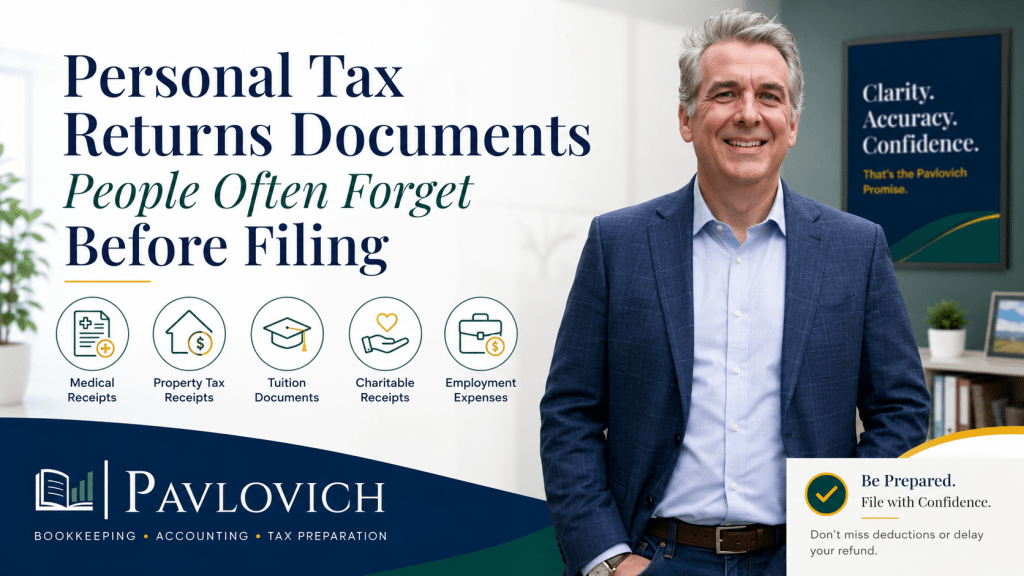
- Mortgage interest statements
- Property tax records
- Charitable contribution receipts
- Medical and dental expense records
- Health savings account documents
- Flexible spending account records
- Retirement contribution records
- Student loan interest statements
- Tuition and education records
- Child care payment information
- Adoption expense records
- Records related to eligible home or energy improvements
The IRS includes child care expenses, mortgage and property tax records, charitable donations, healthcare expenses, retirement contributions, and education expenses among the records taxpayers may need for deductions or credits. (IRS)
Avoid guessing whether an expense qualifies. Give your preparer the documentation and explain what happened. A clear receipt, statement, or payment record provides more useful information than a handwritten total without supporting details.
Include IRS and State Tax Notices
Bring every tax notice or letter you received, even when you believe the issue has already been resolved. Include the complete notice, any response you sent, payment confirmations, and later correspondence.
These documents may explain:
- Changes to a prior return
- A balance due
- A refund adjustment
- Missing information
- Identity verification
- Estimated tax payments
- An amended return
- A payment applied to the wrong period
- A state tax issue
Prior-year returns and government notices belong in your permanent tax file. Well-organized records can also help you respond more effectively when a tax agency asks questions about a filed return. (IRS)
Gather Records for Estimated Tax Payments
If you made federal or state estimated tax payments, provide the date and amount of each payment. Include payments made online, by check, through a tax account, or through an overpayment applied from a prior return.
Do not rely only on memory. A payment confirmation, bank record, or account transcript can help your preparer verify the amount and the tax period to which it was applied.
People often remember making a payment but forget whether it covered federal taxes, state taxes, the current year, or a prior balance. Clear records help prevent the same payment from being missed or counted twice.
Separate Side Jobs and Self-Employment Records
A side job changes the document-gathering process. Even a small amount of freelance, contract, creator, consulting, or gig income may require records beyond a 1099.
Create a separate folder for the activity and include:
- Forms 1099-NEC, 1099-K, or other income forms
- Bank and payment-app statements
- Customer invoices
- Cash income records
- Receipts for business purchases
- Mileage logs
- Equipment records
- Home office information
- Estimated tax payments
- A summary of business income and expenses
- Bookkeeping reports, when available
The IRS recommends keeping statements from banks, payment apps, card processors, and online marketplaces, along with checks, receipts, mileage logs, office-expense records, estimated tax payments, and other business records. (IRS)
Bank deposits alone rarely explain the full business story. A deposit might combine several customer payments, include a transfer, reflect a reimbursement, or show an amount after processing fees. Organized bookkeeping helps your preparer understand what the transactions represent.
For sole proprietors, contractors, consultants, and small LLC owners, tax preparation starts with reliable books. Current financial records make it easier to separate business activity from personal spending and provide a clearer summary of income and expenses.
Include Property and Investment Records
Property and investments can require records from more than one year. Gather purchase documents, sales statements, improvement records, closing documents, brokerage statements, and any information showing how you acquired the asset.
Examples include:
- Stock and investment sales
- Cryptocurrency or other digital asset transactions
- Sale of a home or other property
- Rental property activity
- Inherited property
- Employee stock transactions
- Major home improvements
Keep these records even when a sale did not happen during the current year. Some documents help establish the cost or basis of property later.
The IRS advises taxpayers to keep records that support income, deductions, credits, and property transactions. The appropriate retention period depends on the event the document records and how it affects the return. (IRS)
Create a Simple Tax Folder
You do not need an elaborate filing system. A simple physical folder, secure digital folder, or client portal can work well when you organize it consistently.
Consider creating these sections:
- Personal information
- W-2 and income forms
- Dependents
- Deductions and credits
- Prior-year returns
- IRS and state notices
- Estimated tax payments
- Investments and property
- Side-job or business records
- Questions for your preparer
Add documents as they arrive instead of leaving everything in email, on the kitchen counter, or inside several online accounts. The IRS notes that both labeled paper folders and electronic recordkeeping systems can help taxpayers keep important information together. (IRS)
Use secure methods when sharing sensitive information. Tax documents contain Social Security numbers, banking details, income information, and other personal data that should not travel through unprotected channels.
What Should You Do When a Document Is Missing?
A missing document does not mean you should guess. First, contact the employer, bank, school, brokerage, insurance marketplace, or other organization that issued it.
Next, check whether the form appears in an online account. Many employers and financial institutions provide electronic copies even when the mailed version never arrives.
Your IRS Individual Online Account may also provide transcripts and wage or income information that can assist with filing. However, transcripts may not contain every current document immediately, and they do not replace every missing record in every situation. (IRS)
Tell your preparer what is missing. That conversation can help determine whether you should request another copy, obtain a transcript, wait for a corrected form, or take another appropriate step.
When Does a Return Need Additional Review?
Some situations require more information than a general checklist can cover. Let your preparer know early if your return involves:
- Rental property
- Significant investment activity
- Digital assets
- Income from multiple states
- Foreign income or accounts
- A business with employees
- A partnership or corporation
- An inheritance or estate matter
- An amended return
- Unresolved tax notices
- A previous identity-theft issue
- A major household or custody dispute
Pavlovich Bookkeeping & Accounting prepares personal tax returns and limited small business returns for sole proprietors, small LLCs, and similar straightforward businesses. Our firm is not a CPA firm. Returns involving complex entities, specialized tax matters, audits, or advanced tax planning may require a CPA or another specialized tax professional.
The goal is not to force every situation into the same process. A careful review helps determine what support fits your needs.
What Happens After You Gather Your Documents?
Once your documents are organized, your tax preparer can review the information, identify unanswered questions, and request anything else needed for the return.
Expect the process to include:
- Reviewing your personal and household information
- Comparing income forms with your reported activities
- Discussing major changes from the prior year
- Examining documents related to deductions or credits
- Reviewing side-job or business records
- Clarifying missing or inconsistent information
- Explaining the next step before filing
Complete records do not guarantee a particular refund, credit, or tax result. They provide the information your preparer needs to evaluate the return accurately and explain the outcome clearly.
Start With Organized Information
Personal tax preparation should begin with records, not guesses. Gather your identification details, income forms, dependent information, prior-year returns, tax notices, payment records, and documents that explain major financial events.
Good organization also helps beyond tax season. Clear household and financial records make it easier to answer questions, respond to notices, track important payments, and prepare for the following year.
Pavlovich Bookkeeping & Accounting helps individuals and families organize their information and prepare personal tax returns with a clear, practical process. Schedule a consultation to discuss your tax preparation needs and learn what documents to provide next.