
Key Takeaways
- A bookkeeper tax preparer unifies bookkeeping and tax preparation, aiding businesses in maintaining organized financial records.
- Good bookkeeping throughout the year helps tax preparers work with clearer, accurate information during tax filing.
- Each role has distinct responsibilities: bookkeepers organize records, while tax preparers focus on filing tax returns.
- Consistent financial routines improve not just tax readiness, but also overall business understanding and decision-making.
- Small businesses may require various support, including CPAs for complex issues, while maintaining clear roles among professionals.
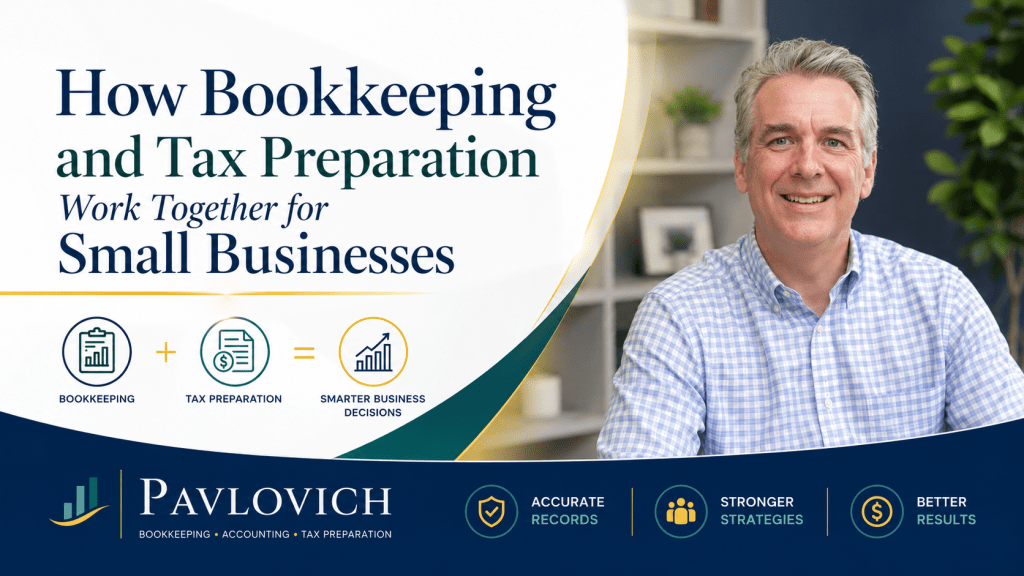
Small business owners often think about bookkeeping and tax preparation as two separate jobs. However, a bookkeeper tax preparer can actually help bridge the gap between these important business functions. Bookkeeping happens during the year, while tax preparation happens when it is time to file a return.
In practice, the two work best when they connect.
Organized bookkeeping gives your tax preparer clearer information. Meanwhile, consistent accounting support and financial reporting help you understand what those numbers mean before tax season arrives. Instead of waiting until filing time to discover missing records, unclear transactions, or reporting problems, you can address questions throughout the year.
That raises an important question: Do you need a bookkeeper, a tax preparer, a CPA, or some combination of support?
The answer depends on your business, the condition of your records, and the type of guidance you need. Understanding how these roles fit together can help you build a better financial process for your business.
A Bookkeeper and Tax Preparer Have Different Responsibilities
A bookkeeper and tax preparer work with some of the same financial information, but they use that information for different purposes.
Your bookkeeper helps keep your financial records organized, current, and useful throughout the year. Depending on the services you receive, that work may include:
- Organizing and categorizing business transactions
- Reconciling bank and credit card accounts
- Reviewing QuickBooks activity
- Identifying missing or unclear transactions
- Maintaining organized financial records
- Preparing financial reports
- Helping keep records ready for tax preparation
A tax preparer focuses on preparing and filing tax returns within the scope of the services they provide.
Some businesses also work with a CPA or another specialized tax professional. That may become appropriate when the business needs more complex tax planning, audit or attestation services, specialized accounting guidance, or help with a complicated business structure.
The goal is not to make one professional replace another. Instead, each person should contribute the type of support the business actually needs.
What a Bookkeeper Does Before Tax Season Arrives
Good bookkeeping creates the financial foundation that your business uses throughout the year.
Consider a contractor who has business income coming into a checking account, expenses charged to two credit cards, equipment financed through a loan, and occasional business purchases made with a personal card.
A bank feed may show the transactions, but it does not automatically explain what each transaction means.
Was a deposit customer income, an owner contribution, a refund, or loan proceeds?
Did a payment include only a loan expense, or did part of the payment reduce the loan balance?
Was a large purchase an ordinary expense, equipment, or several different items combined on one receipt?
A bookkeeper helps organize those details while the information is still available. That can include asking questions, reviewing supporting documents, reconciling accounts, and making sure financial reports reflect the activity recorded in the books.
Without that process, months of transactions can accumulate without enough context to explain what actually happened.
Bookkeeping Should Help You Understand Your Business, Not Just Prepare for Taxes
Tax preparation matters, but organized books should provide value long before you file a return.
Current bookkeeping can support financial reports such as your:
- Profit and loss statement
- Balance sheet
- Cash flow reports
- Accounts receivable information
- Accounts payable information
Each report answers different questions.
A profit and loss statement helps show how much revenue the business generated and what expenses affected its profit during a specific period.
A balance sheet shows what the business owns, what it owes, and the equity recorded at a particular point in time.
Cash flow reporting helps explain how money moves through the business. That matters because a profitable business can still feel short on cash when customers have not paid, debt payments are due, or the business has made significant purchases.
Financial reports become more useful when the underlying bookkeeping stays organized. They can help you notice changes, ask better questions, and understand where your business stands instead of waiting until tax season to look at a full year of activity.
At Pavlovich Bookkeeping & Accounting, this is an important part of our approach. Bookkeeping creates the records. Accounting support and financial reporting help turn those records into information a business owner can understand and use.
What a Tax Preparer Does With Your Financial Information
Once tax preparation begins, your tax preparer uses your records to prepare the appropriate return and address tax filing requirements within their scope.
The IRS notes that paid federal tax return preparers must have a valid Preparer Tax Identification Number, or PTIN. It also explains that tax professionals can have different credentials, qualifications, and representation rights. CPAs, enrolled agents, attorneys, and other tax preparers may therefore offer different levels and types of service. (IRS)
Depending on your business and tax situation, a tax preparer may request information such as:
- Financial statements
- Income records
- Expense details
- Contractor payment information
- Payroll records
- Loan information
- Asset purchase details
- Owner contribution and withdrawal information
- Tax forms
- Supporting documents for specific transactions
The exact documents will depend on the return being prepared. Your tax preparer should tell you what they need.
However, the quality of the bookkeeping still matters.
A profit and loss statement filled with unclear categories creates questions. Unreconciled accounts can make balances harder to trust. Missing transaction details may require the business owner to reconstruct information months after the transaction occurred.
Organized books give the tax preparer a clearer starting point.
Why Good Recordkeeping Matters for Both Bookkeeping and Taxes
Financial reports are only as useful as the information behind them.
The IRS explains that good business records can help a business monitor its progress, prepare financial statements, identify income sources, track expenses, prepare tax returns, and support items reported on those returns. It also notes that business transactions generate supporting documents that provide information needed for the books. (IRS)
That is why bookkeeping involves more than accepting every transaction downloaded from a bank feed.
For example, imagine a business owner spends $425 at a home improvement store.
The bank account shows one $425 charge.
The receipt might show:
- $200 of materials for a customer project
- $125 of tools
- $60 of safety equipment
- $40 of personal items
One bank transaction does not tell the full story.
The same problem can happen with deposits. A $5,000 deposit could represent customer revenue, loan proceeds, money contributed by the owner, or several payments combined into one deposit.
Supporting documents and clear bookkeeping help explain the activity behind the number.
That detail improves the books during the year and gives the tax preparer better information when filing season begins.
How a Bookkeeper and Tax Preparer Work Together
The relationship works best when each professional has clear responsibilities.
Throughout the year, the bookkeeping process keeps financial activity organized. Accounts get reconciled, transactions receive appropriate attention, supporting records remain easier to locate, and financial reports become available for review.
When tax preparation begins, the tax preparer can work from a more organized set of records.
Questions may still arise. That is normal.
Perhaps the tax preparer needs more information about an equipment purchase. Maybe they need clarification about contractor payments or a transaction involving the business owner. In those situations, clear records make it easier to find the information and provide an answer.
The bookkeeper can also work alongside a client’s CPA or other tax professional by maintaining organized, tax-ready financial records.
This type of coordination does not mean the bookkeeper provides CPA services or makes specialized tax decisions. Instead, organized bookkeeping gives the appropriate professional better information to work with.
What Should Be Ready Before You Send Your Books to a Tax Preparer?
Your tax preparer should provide a list based on your specific return. However, a small business often benefits from reviewing several areas before tax preparation begins.
Reconciled bank and credit card accounts
Account reconciliation means comparing the bookkeeping records with outside statements to make sure the activity and balances agree.
A bank feed alone does not complete this process.
Reconciliation can help identify missing transactions, duplicates, incorrect balances, and other issues that may need attention before year-end reports are finalized.
A reviewed profit and loss statement
Look for categories or amounts that do not make sense.
For example:
- Is a major expense unusually high?
- Does income appear complete?
- Are large purchases sitting in an unclear category?
- Are personal transactions mixed with business activity?
- Are there transactions labeled as uncategorized or miscellaneous?
A review does not replace tax analysis. However, it can reveal bookkeeping questions that should be addressed before the reports go to the tax preparer.
A reviewed balance sheet
The balance sheet can reveal issues that a profit and loss statement does not show.
Business owners may need to review:
- Bank balances
- Credit card balances
- Loans
- Assets
- Accounts receivable
- Accounts payable
- Owner equity accounts
Unusual or inaccurate balances may indicate that the books need further review.
Supporting records for important transactions
Certain transactions may require more detail than the accounting software provides.
Examples can include:
- Equipment purchases
- Vehicle purchases
- Loan documents
- Contractor records
- Large or unusual expenses
- Owner contributions
- Business purchases made personally
- Reimbursements
Keeping the supporting information organized can reduce the need to reconstruct the transaction later.
What Happens When the Books Are Behind?
Many small business owners reach tax season and realize their bookkeeping is several months behind.
That does not mean you should feel embarrassed. Business owners often focus on customers, projects, employees, and daily operations until the bookkeeping becomes difficult to catch up on.
The important question is what needs to happen next.
If transactions are simply overdue, catch-up bookkeeping may help bring the records current.
When the books contain incorrect categories, duplicate transactions, unreconciled accounts, reporting problems, or a disorganized QuickBooks setup, bookkeeping cleanup may need to come first.
Once the records are current and reliable, ongoing monthly bookkeeping can help prevent the same situation from repeating.
Starting with the right service matters. A business with eight months of overdue bookkeeping has a different problem from a business whose books are current but inaccurate.
When One Firm Provides Bookkeeping and Tax Preparation
Some small business owners prefer to keep bookkeeping, accounting support, and tax preparation connected when their needs fall within one firm’s scope.
That arrangement can create a more continuous process.
Instead of meeting the business for the first time during tax season, the bookkeeping and accounting team may already understand how the records are organized, what questions arose during the year, and what financial reports have been prepared.
Pavlovich Bookkeeping & Accounting provides services that can include:
- Monthly bookkeeping
- Catch-up bookkeeping
- Bookkeeping cleanup
- Accounting support
- Financial reporting
- QuickBooks setup and support
- Tax-ready financial records
- Personal tax preparation
- Limited small business tax preparation for sole proprietors, small LLCs, and similar simple businesses
Not every client needs every service.
A new client whose books are behind may begin with catch-up bookkeeping. Another business may need cleanup before monthly bookkeeping can start. An owner whose records are current but who does not understand the reports may benefit from accounting support and financial reporting.
The right starting point depends on the problem you are trying to solve.
When Should a Small Business Work With a CPA or Specialized Tax Professional?
Bookkeeping and accounting support do not replace every type of professional service.
Pavlovich Bookkeeping & Accounting is not a CPA firm.
A CPA or another specialized professional may be appropriate when a business needs services such as:
- Audits or attestation services
- Complex tax planning
- Specialized entity guidance
- Complicated partnership or corporate matters
- Complex multi-state tax work
- Advanced tax representation
- Other specialized accounting or tax services
The right professionals can still work together.
A bookkeeper can maintain organized records and prepare useful financial reports. Your tax preparer can handle tax return preparation within their scope. A CPA or specialized professional can address matters that require their credentials or expertise.
Clear boundaries help business owners get the appropriate support without expecting one professional to handle every financial question.
A Better Tax Process Starts Before Tax Season
Waiting until tax season to organize an entire year of business activity can make the process more difficult than it needs to be.
A better approach starts with a consistent financial routine.
Each month, the business can:
- Keep transactions organized
- Reconcile financial accounts
- Review missing or unclear activity
- Maintain supporting records
- Review financial reports
- Address bookkeeping questions while details are still fresh
That routine does more than prepare the business for taxes.
It gives the owner more useful information during the year.
Instead of seeing the books only as something the tax preparer needs, the business owner can use financial information to ask practical questions:
Are sales increasing?
Are expenses changing?
Is the business profitable?
Why does cash feel tight?
Are customers taking longer to pay?
Has debt increased?
Do the numbers match what I expected?
Bookkeeping provides the foundation for answering those questions. Accounting support and financial reporting add context. Tax preparation then becomes one part of a broader financial process rather than the only reason to keep organized records.
Organized Books Create a Better Starting Point
A bookkeeper and tax preparer do different work, but they depend on many of the same financial records.
Consistent bookkeeping helps keep those records organized throughout the year. Financial reporting helps business owners understand what the numbers are showing. When tax season arrives, the tax preparer can begin with clearer information instead of a year of unresolved bookkeeping questions.
For many small businesses, that creates a better process from beginning to end.
You do not need to wait until tax season to find out whether your books are ready.
Need help organizing your bookkeeping, understanding your financial reports, or preparing your records for tax time? Schedule a consultation with Pavlovich Bookkeeping & Accounting to discuss your current situation and determine the right place to begin.