Key Takeaways
- Small business financial reports include Profit & Loss Statement, Balance Sheet, and Cash Flow Statement, each serving a distinct purpose.
- These reports help owners assess profitability, financial position, and cash movement, enabling better decision-making.
- Organized bookkeeping is essential; it supports accurate financial reporting and ensures reliable information.
- A monthly review of reports aids in identifying significant changes and addressing potential issues before they escalate.
- The goal of financial reporting is to help owners ask better questions and understand their business’s financial health.
Small business financial reports should do more than show you a page of numbers. They should help you understand where your business stands, what changed, and what may need your attention.
You do not need an accounting degree to use financial reports. However, you do need organized bookkeeping and enough context to understand what each report can—and cannot—tell you.
Three reports form the foundation of small business financial reporting:
- Profit & Loss Statement
- Balance Sheet
- Cash Flow Statement
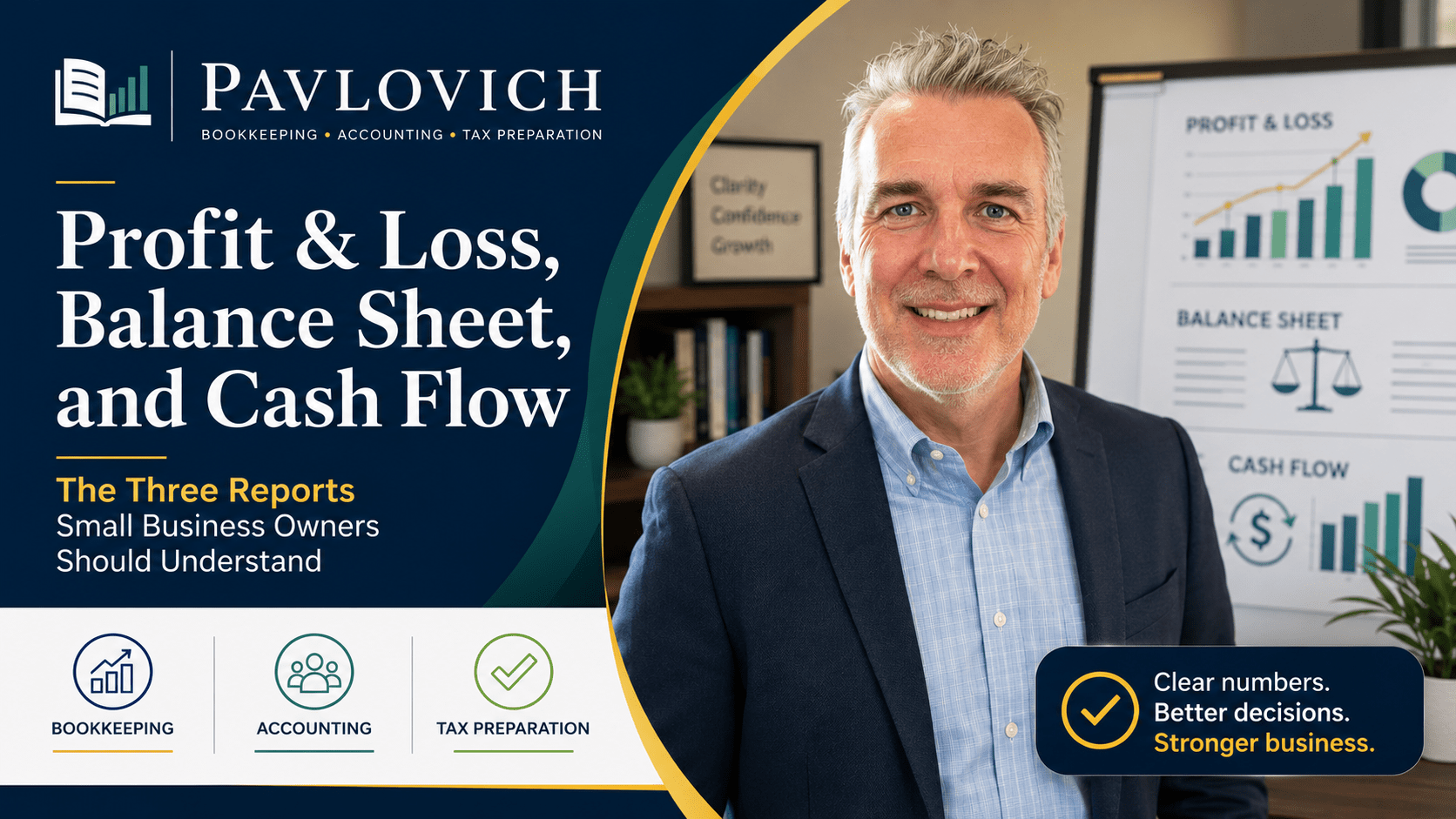
Each answers a different question. The Profit & Loss Statement shows how the business performed over a period of time. The Balance Sheet shows what the business owns and owes at a specific point. The Cash Flow Statement explains how cash moved through the business.
Together, these reports can help you move beyond asking, “How much money is in the bank?” and start asking better questions about profitability, financial position, cash movement, and the decisions ahead.
What Small Business Financial Reports Should Help You Understand
Financial reporting turns organized bookkeeping records into information you can actually use.
The IRS explains that good business records help owners monitor business progress, prepare financial statements, track income and expenses, and prepare tax returns. (IRS)
That distinction matters.
Bookkeeping creates the foundation by organizing transactions, reconciling accounts, and maintaining accurate records. Financial reporting uses that information to show what happened. Accounting support helps you interpret the reports and understand what the numbers may mean for your business.
A good reporting process should help you answer questions such as:
- Is the business profitable?
- Are expenses increasing faster than revenue?
- How much does the business owe?
- How much do customers still owe the business?
- Why is profit different from the cash in the bank?
- Are debt payments affecting available cash?
- Do the numbers match what is actually happening in the business?
- Are the books organized and ready for tax preparation?
No single report answers every question. That is why the Profit & Loss Statement, Balance Sheet, and Cash Flow Statement work best when you review them together.
The Three Main Financial Reports at a Glance
| Financial Report | Main Question It Answers | What It Shows |
|---|---|---|
| Profit & Loss Statement | Did the business earn more than it spent? | Revenue, expenses, and profit or loss over a period |
| Balance Sheet | What does the business own and owe? | Assets, liabilities, and equity on a specific date |
| Cash Flow Statement | Where did the cash come from and where did it go? | Cash movement from operating, investing, and financing activities |
The U.S. Small Business Administration identifies income statements, balance sheets, and cash flow statements as core financial information used to understand and manage a business. (Small Business Administration)
Knowing the purpose of each report makes the numbers much easier to understand.
Profit & Loss Statement: Is the Business Profitable?
The Profit & Loss Statement, often called a P&L or income statement, shows your business income and expenses over a specific period.
You might review a P&L for:
- One month
- One quarter
- Year to date
- A full year
- The same period compared with a prior year
The IRS describes an income statement as a report that shows business income and expenses for a given period. (IRS)
A typical P&L may include:
- Revenue or sales
- Cost of goods sold, when applicable
- Gross profit
- Operating expenses
- Other income or expenses
- Net income or net loss
The exact format depends on the business.
A contractor may need to understand materials, subcontractor costs, vehicle expenses, and insurance. A consultant may focus more heavily on professional services revenue, software, travel, and outside support. A local service business might review payroll, supplies, advertising, rent, and equipment costs.
What Should You Look for on a Profit & Loss Statement?
Start with changes rather than trying to analyze every line.
Ask:
- Did revenue increase or decrease?
- Which expenses changed the most?
- Are any categories unusually high or low?
- Is gross profit changing?
- Are certain costs growing faster than revenue?
- Does the reported profit make sense based on what happened in the business?
Comparisons often make a P&L more useful.
Looking at one month by itself may tell you what happened. Comparing that month with the previous month, the same month last year, or your year-to-date results can help you identify patterns.
For example, suppose a service business reports higher revenue than last month but lower profit. The owner should not stop at the revenue increase. A closer look may show that labor costs, subcontractor expenses, advertising, or materials increased even faster.
The report gives you a starting point. The next step is understanding why the numbers changed.
What a Profit & Loss Statement Does Not Tell You
A profitable P&L does not automatically mean you have plenty of cash.
The report may not fully explain:
- Unpaid customer invoices
- Outstanding bills
- Loan principal payments
- Equipment purchases
- Owner contributions
- Owner draws or distributions
- Changes in credit card balances
- Other timing differences
That is why a business can report a profit while still feeling short on cash.
To understand the rest of the picture, you also need the Balance Sheet and Cash Flow Statement.
Balance Sheet: What Does the Business Own and Owe?
The Balance Sheet shows the financial position of the business on a specific date.
Unlike the P&L, which covers activity over a period, the Balance Sheet works more like a snapshot.
It usually includes three broad categories:
- Assets
- Liabilities
- Equity
The IRS explains that a balance sheet shows a business’s assets, liabilities, and equity on a particular date. (IRS)
Assets
Assets may include:
- Bank account balances
- Accounts receivable
- Inventory
- Equipment
- Vehicles
- Other property owned by the business
Liabilities
Liabilities may include:
- Credit card balances
- Business loans
- Accounts payable
- Payroll liabilities
- Taxes payable
- Other amounts the business owes
Equity
Equity may reflect:
- Owner contributions
- Owner draws or distributions
- Retained earnings
- Accumulated business results
The exact accounts vary depending on the business structure and bookkeeping system.
What Should You Look for on a Balance Sheet?
A Balance Sheet can help you ask questions that the P&L cannot answer.
For example:
- Do the bank balances agree with reconciled accounts?
- Do credit card balances look correct?
- How much do customers still owe?
- Are unpaid bills building up?
- Do loan balances make sense?
- Are there old balances that should have been cleared?
- Does owner activity appear organized?
- Are any accounts negative when they should not be?
- Do any numbers look unfamiliar or unexpected?
A Balance Sheet often reveals bookkeeping problems that remain hidden when someone reviews only the P&L.
Consider a loan payment.
Part of the payment may reduce the loan balance, while another part may represent interest expense. If someone records the entire payment as an expense, the P&L may overstate expenses and the Balance Sheet may continue showing the wrong loan balance.
The bank transaction happened correctly. However, the accounting behind it did not.
That example shows why organized bookkeeping involves more than categorizing bank feed transactions.
Cash Flow Statement: Where Did the Cash Go?
The Cash Flow Statement explains how cash moved into and out of the business over a period.
Cash flow deserves attention because profit and cash do not always move together.
A business may report a profit while cash decreases. Another business may receive a loan and see its bank balance increase even though the borrowed money is not operating revenue.
A Cash Flow Statement helps separate those movements.
It commonly organizes cash activity into three areas:
Operating Activities
Operating activities generally relate to the day-to-day business.
Examples may include cash received from customers and cash paid for:
- Payroll
- Rent
- Vendors
- Supplies
- Insurance
- Other operating expenses
Investing Activities
Investing activities may involve the purchase or sale of longer-term business assets, such as equipment.
Financing Activities
Financing activities may include:
- Borrowing money
- Repaying debt
- Owner contributions
- Certain owner-related cash movements
A Cash Flow Statement shows how those activities contributed to the change in cash during the reporting period. (QuickBooks)
What Should You Look for on a Cash Flow Statement?
Ask:
- Did cash increase or decrease?
- Did normal business operations generate cash?
- Did customers pay more slowly?
- Did the business make a large equipment purchase?
- Did debt payments reduce available cash?
- Did owner activity affect the bank balance?
- Are upcoming obligations likely to put pressure on cash?
These questions help explain why the amount in your bank account may tell a different story from the profit shown on your P&L.
Why Profit and Cash Can Tell Different Stories
Suppose a consulting business completes $20,000 of work during the month but has only collected $12,000 from customers.
Depending on its accounting method and circumstances, the P&L may reflect income that does not yet sit in the bank account.
Meanwhile, the business still needs to pay:
- Contractors
- Software subscriptions
- Insurance
- Rent
- Loan payments
- Other operating costs
The business may appear profitable while cash feels tight.
A different situation can create the opposite effect.
Suppose an owner contributes $15,000 to the business or receives loan proceeds. The bank balance increases, but that cash does not necessarily mean the business earned a $15,000 profit from operations.
This is why checking the bank balance alone does not give you a complete picture of business performance.
How the Three Financial Reports Work Together
Each financial statement gives you one part of the story.
The Profit & Loss Statement tells you about performance.
The Balance Sheet tells you about financial position.
The Cash Flow Statement tells you about cash movement.
When you review all three, the connections become more useful.
Imagine that your P&L shows a healthy profit, but the bank account keeps declining.
The Balance Sheet may show that customers owe a growing amount of money. Meanwhile, the Cash Flow Statement may reveal that debt payments or equipment purchases are using significant cash.
Without reviewing the reports together, you might conclude that one of the reports is wrong.
Instead, each report may be showing a different part of the same situation.
That is the real value of financial reporting. The reports should help you connect the numbers rather than look at each statement in isolation.
Reliable Financial Reports Start With Organized Bookkeeping
A report can look professional and still contain unreliable information.
Financial reporting depends on the bookkeeping behind it.
Problems may arise when:
- Bank or credit card accounts have not been reconciled
- Transactions remain uncategorized
- Personal and business activity gets mixed together
- Duplicate transactions enter the books
- Loan payments receive the wrong treatment
- Transfers appear as income or expenses
- Old accounts remain on the books
- Customer or vendor balances are inaccurate
- The chart of accounts has become disorganized
- Bank rules automatically categorize transactions incorrectly
The IRS emphasizes that good records support accurate financial statements and help businesses monitor their progress. (IRS)
That means financial reporting should begin with a simple question:
Can you trust the bookkeeping behind the report?
Monthly bookkeeping creates the foundation by keeping records organized, reconciling accounts, reviewing unclear activity, and maintaining a consistent process.
From there, financial reporting becomes much more useful.
What Small Business Owners Should Review Each Month
You do not need to spend hours studying every account.
A focused monthly review can help you understand the most important changes.
Review the Profit & Loss Statement
Look at:
- Total revenue
- Major expense categories
- Gross profit, when applicable
- Net income or loss
- Significant changes from previous periods
Ask what changed and why.
Review the Balance Sheet
Look at:
- Cash balances
- Accounts receivable
- Credit cards
- Loans
- Accounts payable
- Other large or unusual balances
Pay attention to numbers that seem old, unexpected, or inconsistent with what you know about the business.
Review Cash Flow
Consider:
- Whether cash increased or decreased
- How much cash came from normal operations
- Whether debt payments affected cash
- Whether large purchases created a temporary decrease
- What upcoming obligations may require cash
Review the Business Behind the Numbers
Financial reports become more useful when you connect them to real business activity.
Ask:
- Did we add or lose a major customer?
- Did prices change?
- Did material costs increase?
- Did we hire someone?
- Did seasonality affect revenue?
- Did a customer pay late?
- Did we buy equipment?
- Did we take on new debt?
- Did the owner take more money out of the business?
Accounting reports show the results. Business context helps explain them.
Financial Reporting Should Help You Ask Better Questions
The goal of small business financial reporting is not to turn every owner into an accountant.
Instead, reports should help you become a more informed business owner.
Useful questions may include:
- Why did profit change this month?
- Which costs increased?
- Are customers paying on time?
- Is debt increasing or decreasing?
- Why is cash different from profit?
- Are we carrying old balances that need review?
- Do our reports reflect what is actually happening in the business?
- Are the books organized enough for tax preparation?
- What should we monitor more closely next month?
Sometimes the most valuable result of a financial report is not an immediate answer.
It is knowing which question to ask next.
When You Need More Than a Report
Accounting software can generate reports quickly. That does not mean the reports automatically provide useful financial understanding.
A business owner may have a P&L, Balance Sheet, and Cash Flow Statement available in QuickBooks but still wonder:
- Which numbers matter most?
- Why did a balance change?
- Is a trend normal?
- Does the report contain a bookkeeping problem?
- Should two periods be compared?
- Does the business need cleanup before relying on the reports?
That is where accounting support becomes valuable.
Bookkeeping creates organized financial information. Financial reporting presents that information. Accounting support helps you review the numbers in context and understand what deserves attention.
The goal is not to provide complicated accounting commentary. It is to help small business owners make sense of their numbers through clear reports, practical explanations, and an organized monthly process.
Financial Reports Also Support Tax-Ready Records
Financial reports serve a broader purpose than tax preparation, but organized books can make tax time much easier.
The IRS notes that good records help businesses prepare financial statements and tax returns while supporting the income and expenses reported on those returns. (IRS)
Throughout the year, consistent bookkeeping can help keep important information organized, including:
- Business income
- Expense categories
- Contractor activity
- Loan balances
- Asset purchases
- Owner activity
- Bank and credit card reconciliations
- Other records your tax preparer may need
Waiting until tax season to review an entire year of activity can create unnecessary confusion.
By contrast, monthly bookkeeping and financial review allow questions to come up while transactions are still relatively recent.
Clean books do not guarantee a particular tax result. They do, however, create a more organized foundation for tax preparation.
Pavlovich Bookkeeping & Accounting is not a CPA firm. For audits, complex tax matters, advanced tax planning, or other specialized accounting needs, a CPA or another qualified professional may be appropriate.
What to Do When Your Financial Reports Do Not Make Sense
Do not assume that confusing reports mean you are bad at understanding accounting.
Sometimes the bookkeeping needs attention first.
You may need a closer review when:
- Bank balances do not match
- Credit card balances look wrong
- Profit seems unrealistic
- Loan balances never change correctly
- Old transactions remain unresolved
- Reports contain large uncategorized amounts
- Owner transactions are unclear
- Accounts receivable or accounts payable do not match reality
- You do not trust the numbers enough to use them
Depending on the condition of the books, the right starting point may be:
- Bookkeeping cleanup
- Catch-up bookkeeping
- QuickBooks support
- Monthly bookkeeping
- Financial reporting
- Ongoing accounting support
The best solution depends on the underlying problem.
For example, a business that sits eight months behind may need catch-up bookkeeping before monthly reporting becomes useful. A company with current books but confusing reports may need stronger financial reporting and accounting support. Another business may need QuickBooks cleanup before anyone can rely on the numbers.
Better Reports Begin With Better Financial Organization
The Profit & Loss Statement, Balance Sheet, and Cash Flow Statement each tell you something important about your business.
The P&L helps you understand performance.
The Balance Sheet shows what the business owns and owes.
The Cash Flow Statement explains how cash moved.
Together, they give you a much clearer picture than any single number or bank balance.
However, the reports are only the beginning.
Organized bookkeeping gives you reliable information. Financial reporting helps you see what happened. Accounting support helps you understand why the numbers changed and what deserves your attention next.
That is how small business financial reports become more than paperwork. They become a practical way to understand where your business stands.
Need clearer financial reports or help getting your books organized? Schedule a consultation with Pavlovich Bookkeeping & Accounting to discuss your bookkeeping, financial reporting, and accounting support needs.