Key Takeaways
- A profit and loss statement shows your business’s income and expenses over a specific period.
- Know what period the report covers and whether it uses cash or accrual accounting before analyzing the numbers.
- Compare revenue, direct costs, and operating expenses to understand your business performance better.
- Review consistent categories in your bookkeeping to identify trends and unusual expenses over time.
- Your P&L should help you ask meaningful questions and guide better business decisions, not just serve for tax readiness.
A profit and loss statement can look like a wall of accounting terms when you do not work with financial reports every day. If you want to understand your finances, it’s important to know how to read a profit and loss statement. However, the basic purpose is straightforward: it shows what your business earned, what it spent, and whether it produced a profit or loss during a specific period.
You may also hear this report called a P&L or an income statement. Whatever name your bookkeeping software uses, the report should do more than give you a number at the bottom of the page. A useful P&L helps you understand how your business is performing, where your money is going, and what questions you may need to ask next.
That is why learning how to read a profit and loss statement matters. Bookkeeping creates the financial records behind the report, while accounting support and financial reporting help turn those records into information you can actually use.
What Is a Profit and Loss Statement?
A profit and loss statement summarizes your business income and expenses over a specific period.
You might run the report for:
- One month
- One quarter
- Year to date
- A full year
- A custom date range
Most small business owners benefit from reviewing the P&L regularly rather than waiting until tax season. A year-end report tells you where the business ended up. Monthly reports help you see what changed along the way.
The IRS describes an income statement as a financial statement that shows a business’s income and expenses for a given period. The agency also explains that organized business records help owners monitor progress and prepare financial statements and tax returns. (IRS)
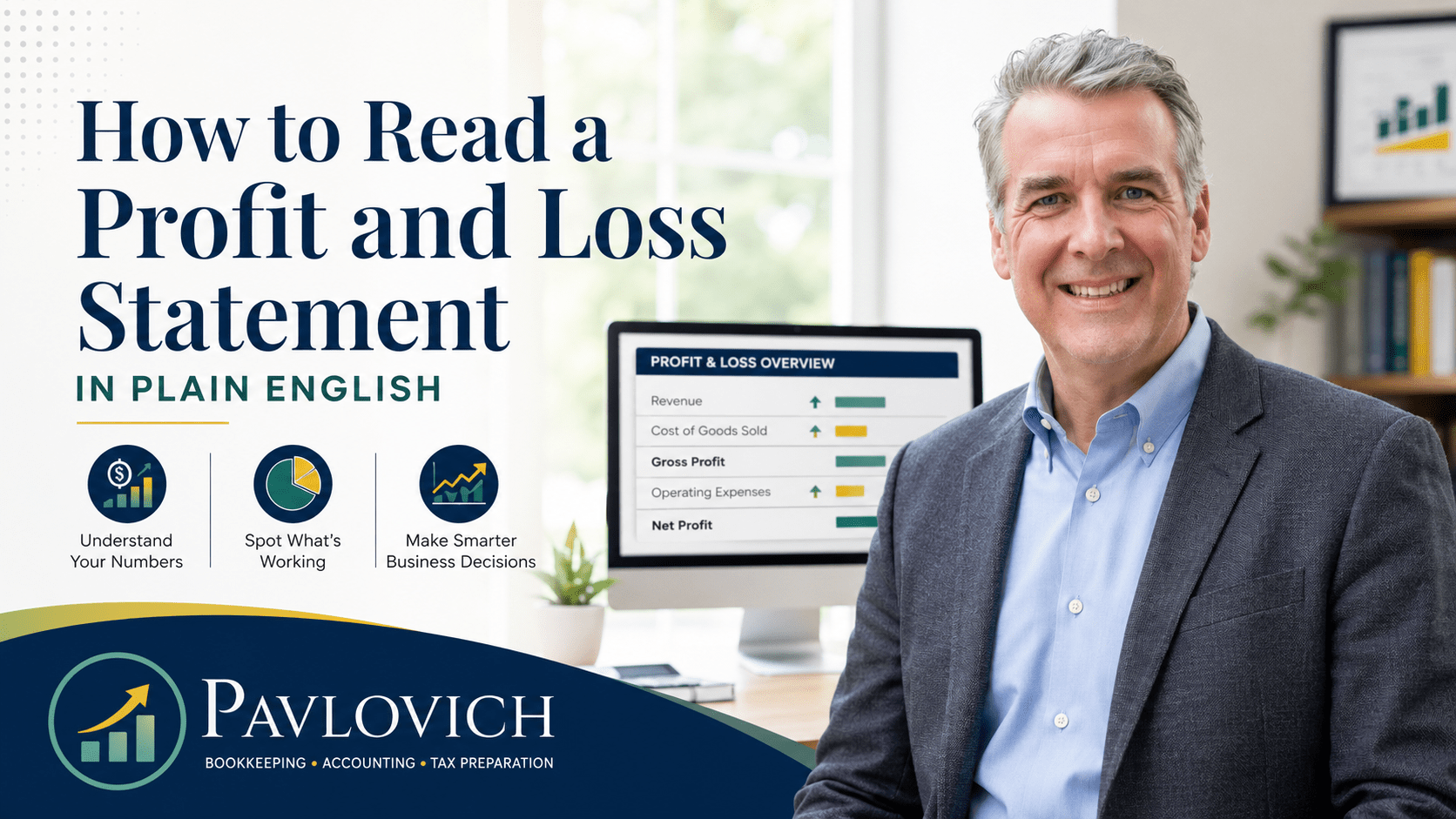
A basic P&L may include:
Revenue
The income the business earned.
Cost of goods sold or direct costs
Costs directly connected to producing what the business sells, when applicable.
Gross profit
Revenue remaining after direct costs.
Operating expenses
The costs of running the business.
Net income or net loss
The amount remaining after the report accounts for income and expenses.
Not every small business will use every section. A consultant may have a relatively simple P&L, while a contractor, retailer, or product-based business may need more detailed direct-cost categories.
Before You Read the Numbers, Check the Reporting Period
The first step in reading a profit and loss statement is making sure you know what period the report covers.
A P&L for June tells a different story from a year-to-date report covering January through June. Likewise, comparing one month with an entire prior year will not give you a useful comparison.
Start by checking:
- The beginning date
- The ending date
- Whether you are looking at one month or a longer period
- Whether you have comparison columns
- Whether the report uses the accounting method appropriate for your books
Accounting method can affect when income and expenses appear. Under cash-basis accounting, transactions generally appear when money changes hands. Under accrual accounting, income and expenses may appear when they are earned or incurred instead. The U.S. Small Business Administration explains this timing difference between cash and accrual accounting methods. (SBA)
You do not need to become an accountant to review your P&L. Still, you should understand what period and accounting method you are looking at before drawing conclusions from the numbers.
Revenue Shows What the Business Earned
Revenue usually appears near the top of the profit and loss statement.
Depending on the business, revenue may come from:
- Service fees
- Client projects
- Monthly retainers
- Product sales
- Consultation fees
- Contract work
- Other business income
Start by asking whether the revenue number makes sense based on what happened in the business.
For example, a contractor who completed several large projects might expect revenue to increase. A consultant who lost a recurring client may see a decrease. A seasonal business could have predictable high and low months.
The important question is not simply, “Did revenue go up?”
Ask why it changed.
Consider questions such as:
- Did you serve more customers?
- Did you complete larger projects?
- Did you raise your prices?
- Did a recurring client leave?
- Did several customer payments arrive in a different month than expected?
- Does the revenue shown on the report match what you believe the business actually earned?
Revenue gives you a starting point, but it does not tell you whether the business made money.
A company can generate strong sales and still struggle if expenses rise just as quickly—or faster.
Cost of Goods Sold and Direct Costs Show What It Took to Produce Revenue
Some businesses have a section for cost of goods sold, often called COGS, or other direct costs.
These are costs directly connected to the product or service the business sells.
For example, a contractor might track certain job materials as direct costs. A retailer may track inventory costs. A manufacturer might have materials and production expenses.
Service businesses may have fewer direct costs, although the exact structure depends on how the company operates.
After subtracting cost of goods sold from revenue, the report may show gross profit.
A simplified formula looks like this:
Revenue − Cost of Goods Sold = Gross Profit
Suppose a business earns $50,000 in revenue and has $20,000 in direct costs.
Its gross profit would be:
$50,000 − $20,000 = $30,000
That $30,000 still needs to cover the business’s regular operating expenses.
Gross profit can help you understand whether the core work of the business leaves enough income to support the rest of the company. However, the number becomes useful only when your bookkeeping categories reflect how your business actually operates.
Copying another company’s chart of accounts or placing costs wherever they seem convenient can make the report harder to understand.
Operating Expenses Show What It Costs to Run the Business
Operating expenses are the costs of keeping the business running.
Depending on your company, these may include:
- Rent
- Insurance
- Software subscriptions
- Advertising
- Professional services
- Bookkeeping and accounting
- Office supplies
- Phone and internet service
- Bank fees
- Small tools
- Vehicle expenses
- Contractor costs
- Other administrative expenses
This section often tells a more useful story when you compare it over time.
A higher expense is not automatically a problem.
For example, advertising costs may increase because you launched a campaign. Insurance might spike because you paid an annual premium. Supply costs may rise because the business took on more work.
Context matters.
Instead of looking at an expense and immediately deciding that it is too high, ask:
What caused the change?
A useful P&L should help you connect the financial report with what actually happened in the business.
Consistent Categories Make Expenses Easier to Understand
Bookkeeping categories affect how useful your profit and loss statement becomes.
Imagine that your business pays for several software subscriptions each month.
One month, those costs appear under software. The next month, similar charges land under office expenses. Later, another subscription gets placed in miscellaneous expenses.
The total amount of money leaving the business has not changed. However, the P&L now makes it harder to answer a simple question:
How much are we actually spending on software?
Consistent categories make month-to-month comparisons more meaningful.
They can help you identify:
- Rising costs
- Duplicate subscriptions
- Unusual expenses
- Seasonal changes
- New spending patterns
- Areas that need a closer review
This is one reason bookkeeping should not stop at simply recording transactions. Organized financial records create the foundation, but the real value comes from being able to understand what those records are telling you.
Net Income Shows the Bottom Line
Near the bottom of the profit and loss statement, you will usually find net income or net loss.
In simple terms:
Revenue − Expenses = Net Income
When revenue exceeds expenses, the P&L shows a profit.
When expenses exceed revenue, it shows a loss.
Suppose a business reports:
- $40,000 in revenue
- $10,000 in direct costs
- $22,000 in operating expenses
The simplified calculation would be:
$40,000 − $10,000 − $22,000 = $8,000 net income
That $8,000 tells you the business reported a profit for the period.
However, the bottom line should never become the only number you review.
A profitable month may still create cash flow pressure. A month showing a loss may include a large annual expense or another unusual event.
The better question is:
What caused the result?
Financial reporting becomes more useful when you look beyond the final number and understand what changed above it.
Why Profit Does Not Always Match Your Bank Balance
One of the most common questions business owners ask is:
“My P&L says I made a profit. Why isn’t that money in my bank account?”
Profit and cash are related, but they are not the same thing.
Several transactions can affect cash without appearing as ordinary expenses on the profit and loss statement.
For example:
Owner draws or distributions
Money taken out by an owner may reduce the bank balance without appearing as a regular business expense.
Loan principal payments
Part of a loan payment may reduce a liability rather than appear as an expense.
Equipment purchases
Depending on how an item is recorded, the full cash payment may not appear as an ordinary expense on the P&L at the time of purchase.
Credit card activity
The timing of purchases and credit card payments can make the movement of cash look different from expenses on the report.
Unpaid customer invoices
Under accrual accounting, revenue may appear before the customer pays.
Timing differences
Income and expenses may fall into different reporting periods depending on the business’s accounting method.
Because of these differences, a P&L tells only part of your financial story.
Your balance sheet, cash flow information, bank reconciliations, accounts receivable, accounts payable, and other financial records can provide additional context.
That is why financial reporting should not focus on one report in isolation.
How to Read a Profit and Loss Statement Each Month
You do not need to study every line for hours.
A practical monthly review can follow a simple process.
1. Review Revenue
Start at the top of the report.
Ask:
- Did revenue increase or decrease?
- Does the number match the level of business activity?
- Were there any unusually large sales or projects?
- Did customer payment timing affect the result?
- Does any income look missing or duplicated?
The goal is to connect the number with what happened in the business.
2. Review Direct Costs and Gross Profit
When your business tracks cost of goods sold or direct costs, look at how those costs changed along with revenue.
For example, if revenue increased significantly, you might expect certain direct costs to rise too.
However, a sharp increase in direct costs without a similar increase in revenue deserves a closer look.
Ask whether:
- Material prices increased
- Job costs changed
- Vendor pricing changed
- Transactions landed in the wrong categories
- The business took on a different type of work
Gross profit becomes more meaningful when you understand what is driving it.
3. Review Major Operating Expenses
Focus first on your larger or more important expense categories.
Look for:
- Significant increases
- Significant decreases
- New recurring expenses
- Unexpected charges
- Vague categories
- Duplicate transactions
Some changes will make sense immediately. Others may require a receipt, invoice, vendor statement, or transaction review.
4. Review Net Income
Next, look at the bottom line.
Did the business report a profit or loss?
More importantly, does the result make sense based on what happened during the month?
A surprising number does not always mean the report is wrong. It may mean you need more context.
5. Compare the Report With Earlier Periods
One month by itself can be misleading.
A business may have a seasonal slowdown, an annual insurance payment, a large project, or a one-time expense.
Comparing periods can help you identify patterns instead of reacting to one isolated number. QuickBooks, for example, provides reporting options that can compare profit and loss results across different periods. (QuickBooks)
You might compare:
- This month with last month
- This month with the same month last year
- Year to date with the prior year
- Several consecutive months
Trends often tell you more than a single result.
Five Questions to Ask When You Review Your P&L
A useful monthly review does not require an accounting degree.
Start with five practical questions.
What changed?
Look for meaningful increases or decreases in revenue, direct costs, expenses, and net income.
Why did it change?
Connect the financial result with actual business activity.
Does the report match what happened in the business?
Your numbers should make sense when compared with completed work, customer activity, major purchases, and other events.
Is the change temporary or becoming a trend?
One unusual month may not require action. A pattern that continues for several months deserves more attention.
What do I need to understand before making a decision?
Sometimes the P&L answers the question. Other times, you may need information from the balance sheet, cash flow records, customer invoices, vendor bills, or other reports.
The purpose of reviewing financial statements is not to find a reason to worry about every change. It is to understand the business well enough to ask better questions.
What Should You Question When the P&L Looks Wrong?
A profit and loss statement should help you understand your business.
When the report does not match what you expected, investigate before relying on it.
Possible warning signs include:
- Revenue appears unusually high or low
- Income seems to be missing
- Transfers appear as revenue
- Duplicate expenses appear
- Personal purchases appear in business expense categories
- Large amounts sit in uncategorized or miscellaneous accounts
- Expense categories change inconsistently from month to month
- The report includes transactions from the wrong period
- Net income seems completely disconnected from actual business activity
These issues do not necessarily mean the business has a serious accounting problem. Often, they point to bookkeeping that needs review, reconciliation, cleanup, or better organization.
Still, decisions based on unreliable reports can create confusion.
Before using a P&L to evaluate performance, make sure you trust the records behind it.
A Profit and Loss Statement Is Only as Reliable as the Bookkeeping Behind It
A polished report does not automatically mean the numbers are accurate.
Bookkeeping software can generate a P&L even when the underlying records contain problems.
For example:
- Duplicate transactions can overstate expenses.
- Transfers recorded as income can overstate revenue.
- Missing transactions can understate income or expenses.
- Unreconciled accounts can hide discrepancies.
- Inconsistent categories can make comparisons unreliable.
- Personal and business transactions mixed together can distort the report.
Monthly bookkeeping helps address these issues before they accumulate.
Regular categorization, account reconciliations, document review, and financial reporting create a stronger foundation for understanding your numbers.
When books have fallen behind, catch-up bookkeeping may bring overdue months current. If the records contain errors or inconsistent organization, bookkeeping cleanup may need to come first.
After the records become current and reliable, ongoing bookkeeping and accounting support can help turn monthly reports into something more useful than a tax-time requirement.
How Accounting Support Makes the P&L More Useful
Reading the numbers is one step.
Understanding what they mean for your business is the next.
For example, imagine your revenue increased by 15%.
That sounds positive.
However, suppose direct costs increased by 30% and operating expenses also climbed. Revenue went up, but the additional sales may not have produced the improvement you expected.
Another business may show flat revenue for three months while steadily reducing unnecessary expenses. Its sales did not grow, but its overall financial position may still be improving.
Neither story appears in one number alone.
Accounting support helps business owners review financial information in context.
That may include looking at:
- Changes in revenue
- Expense trends
- Gross profit
- Net income
- Cash flow
- Accounts receivable
- Accounts payable
- Balance sheet activity
- Unusual transactions
- Month-to-month comparisons
The goal is not to overwhelm you with accounting terminology.
The goal is to help you understand where your business stands.
Your P&L Can Help You Make Better Business Decisions
A profit and loss statement cannot make decisions for you.
However, reliable financial information can help you make decisions with more context.
For example, your reports may help you think through questions such as:
- Can the business support another recurring expense?
- Are certain costs rising faster than revenue?
- Did a marketing campaign coincide with higher sales?
- Is a new service producing enough revenue to justify its costs?
- Are several small subscriptions adding up to a significant expense?
- Does the business have seasonal patterns that require planning?
- Are you earning more revenue without improving profitability?
The P&L does not always provide the complete answer.
Still, it gives you a starting point.
When combined with a balance sheet, cash flow information, and organized bookkeeping records, financial reporting can provide a much clearer picture of the business.
Profit and Loss Statements Also Support Tax-Ready Records
Your P&L serves a broader purpose than tax preparation, but organized books also make tax time easier.
The IRS explains that good records help business owners track income and expenses, prepare financial statements, prepare tax returns, and support information reported on those returns. (IRS)
Keeping your bookkeeping current throughout the year can make it easier to review:
- Business income
- Expense categories
- Contractor payments
- Professional fees
- Software costs
- Vehicle or mileage records
- Other supporting business records
A P&L does not replace tax preparation, and the report alone may not contain everything needed for a tax return.
However, organized bookkeeping and reliable financial reports create a much better starting point than trying to rebuild an entire year of business activity at tax time.
Pavlovich Bookkeeping & Accounting provides bookkeeping, accounting support, financial reporting, QuickBooks support, and tax preparation for qualified personal and small business situations. We are not a CPA firm, and businesses with audits, complex tax matters, or specialized accounting needs may need support from a CPA or another specialized professional.
Your P&L Should Help You Understand Your Business
A profit and loss statement should not be a report you open once a year and immediately send to someone else.
It should help you understand:
- What the business earned
- What the business spent
- Whether it produced a profit or loss
- What changed from prior periods
- Which trends deserve attention
- What questions you should ask next
Clean bookkeeping creates the foundation for that understanding.
Clear financial reporting adds context.
Practical accounting support helps you use the information instead of simply receiving another report.
You do not need to memorize every accounting term or analyze every transaction yourself. You do need reliable records and reports that reflect what is actually happening in your business.
Pavlovich Bookkeeping & Accounting helps small business owners make sense of their numbers through organized bookkeeping, practical accounting support, and clear financial reporting.
Need help understanding what your financial reports are telling you? Schedule a consultation to discuss your bookkeeping and accounting support needs.