Key Takeaways
- Clean books at tax time lead to more accurate filings and reduce stress from disorganized records.
- They help clarify business income and distinguish between various transactions, preventing misstatements.
- Clear expense categories and supporting documents simplify tax preparation and minimize questions from tax professionals.
- Regularly reconciling accounts strengthens financial records and uncovers discrepancies before tax season.
- Consistent monthly bookkeeping prevents year-end cleanup, providing better insights and readiness for tax responsibilities.
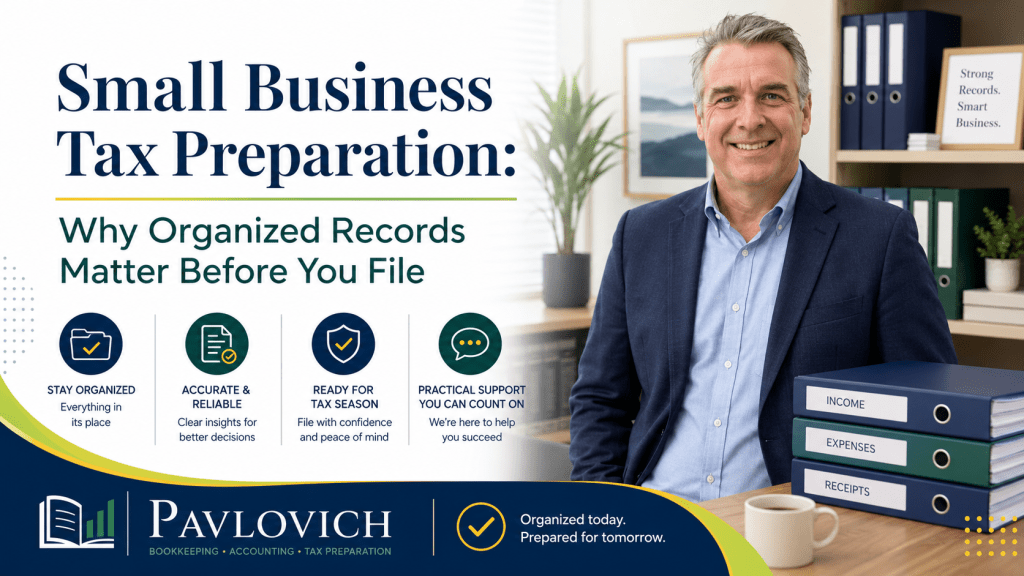
Tax season becomes much easier when your financial records already tell a clear story. Keeping clean books at tax time ensures you can file with confidence and accuracy.
For many small business owners, the stress does not come from a single tax form or filing deadline. Instead, it builds through months of uncategorized transactions, missing receipts, unreconciled accounts, unclear deposits, personal purchases, and bookkeeping questions that never received an answer.
Clean books reduce that last-minute scramble. They give your tax preparer or CPA organized information to review, help you respond to questions more confidently, and create a clearer picture of how your business performed during the year.
However, tax preparation represents only one benefit. Accurate bookkeeping also supports reliable financial reporting, better business decisions, and a stronger understanding of where your business stands.
What Does It Mean to Have Clean, Tax-Ready Books?
Clean books contain financial information that has been organized, reviewed, and supported by appropriate records.
Tax-ready bookkeeping does not mean every tax question has already been resolved. Your tax preparer still needs to evaluate your situation and determine how tax rules apply. Instead, tax-ready books provide a reliable starting point for that work.
Depending on your business, clean books may include:
- Categorized income and expenses
- Reconciled bank and credit card accounts
- Properly recorded loan payments and transfers
- Clearly identified owner contributions and withdrawals
- Reviewed accounts receivable and accounts payable
- Organized contractor and payroll records
- Financial reports that reflect the bookkeeping records
- Receipts, invoices, statements, and other supporting documents
The IRS allows businesses to choose a recordkeeping system that fits their needs, but the system must clearly show income and expenses. It should also include supporting documents for purchases, sales, payroll, assets, and other business transactions. (IRS)
Good bookkeeping brings those pieces together so your records remain useful throughout the year—not only when it is time to file a return.
Clean Books Show Business Income More Clearly
Business income does not always appear as one simple deposit.
A contractor may receive checks, credit card payments, and electronic transfers. A consultant might collect retainers, reimbursements, and invoice payments through several platforms. Retail and service businesses may also deal with refunds, processing fees, sales tax, and deposits that combine multiple transactions.
Those details matter because the amount deposited into a bank account may not equal the business’s total sales.
For example, suppose a payment processor collects $5,000 from customers, deducts $150 in fees, and deposits $4,850 into the business checking account. Recording only the deposit could understate both revenue and processing expenses.
Clean bookkeeping separates the gross sales, fees, refunds, transfers, and other activity. As a result, the profit and loss statement presents a more useful picture of what the business earned and spent.
Your tax preparer can then begin with organized information instead of trying to rebuild income from bank deposits alone.
Clear Expense Categories Reduce Tax-Time Questions
Every business expense should have a clear purpose.
Temporary categories such as “miscellaneous,” “uncategorized,” or “ask accountant” may help you move past a transaction during the year. Unfortunately, a long list of vague entries creates more work when tax season arrives.
Useful expense categories help explain how the business operates. Depending on the company, those categories might include:
- Advertising
- Contract labor
- Insurance
- Meals
- Office supplies
- Professional services
- Rent
- Repairs and maintenance
- Software subscriptions
- Tools and equipment
- Vehicle expenses
A category alone may not provide enough information for every transaction. Large purchases, meals, travel expenses, contractor payments, and unusual charges may also need receipts, descriptions, or other documentation.
The IRS explains that supporting records for business expenses should identify details such as the payee, amount, proof of payment, date, and description of the item or service. (IRS)
Reviewing those details throughout the year makes them easier to explain. Waiting until tax season often means trying to remember the purpose of a purchase made several months earlier.
Reconciled Accounts Create More Reliable Records
Connecting a bank account to QuickBooks does not automatically create accurate bookkeeping.
Bank feeds can import transactions, but someone still needs to review the activity, match deposits and payments, identify transfers, correct duplicates, assign categories, and reconcile the account.
Reconciliation means comparing the transactions in the bookkeeping system with the corresponding bank or credit card statement. The process should confirm that the recorded balance agrees with the statement balance.
QuickBooks describes reconciliation as matching the transactions entered in the software with bank and credit card statements. It also recommends completing the comparison until the difference reaches zero. (QuickBooks)
Regular reconciliation can uncover problems such as:
- Duplicate transactions
- Missing deposits
- Incorrect beginning balances
- Unrecorded bank fees
- Old transactions that never cleared
- Transfers recorded as income or expenses
- Deleted or changed entries
- Credit card payments recorded incorrectly
These issues can affect both financial reports and tax preparation. A profit and loss statement may appear reasonable while the bank balance remains wrong. Likewise, an inaccurate credit card account can leave expenses missing or duplicated.
Monthly reconciliation gives your reports a stronger foundation.
Financial Reports Help You Review the Story Behind the Numbers
Clean bookkeeping should produce financial reports that business owners can understand and use.
The profit and loss statement shows income and expenses over a period of time. Meanwhile, the balance sheet shows what the business owns, what it owes, and the owner’s financial interest at a specific date. Cash flow information helps explain how money moved through the business.
Reviewing these reports before tax preparation can reveal issues that deserve attention.
For example, a profit and loss statement might show unusually high spending on supplies or software. The balance sheet could contain an old loan balance, a negative bank account, an unexplained asset, or a large amount sitting in an uncategorized account.
Those balances do not automatically mean the bookkeeping is wrong. However, they give the business owner, bookkeeper, and tax professional a place to begin asking questions.
Financial reports also support better decisions outside tax season. A business owner can use them to compare revenue, monitor expenses, review profitability, watch cash flow, and identify trends over time.
That is why bookkeeping should do more than record transactions. Organized records create information. Accounting support and financial reporting help the owner understand what that information means.
Supporting Documents Complete the Financial Picture
Accurate numbers still need documentation behind them.
Depending on the business and tax situation, supporting records may include:
- Bank and credit card statements
- Customer invoices
- Vendor bills
- Receipts
- Payroll reports
- Contractor payment records
- Loan statements
- Equipment purchase documents
- Mileage logs
- Deposit records
- Sales tax reports
- Payment processor statements
The IRS identifies documents such as invoices, receipts, deposit slips, paid bills, account statements, and proof of electronic payments as records that can support entries in a business’s books and tax return. It also recommends keeping records organized and stored safely. (IRS)
A complicated filing system is not necessary for every company. Consistency matters more.
Some owners create digital folders organized by year and month. Others use receipt-capture software or a secure portal to share documents with their bookkeeping and accounting team. Whatever system you choose, everyone involved should know where to find the records.
When documents stay organized throughout the year, tax season no longer begins with a search through email inboxes, glove compartments, desk drawers, and old paper folders.
Clean Books Help Your Bookkeeper and Tax Professional Work Together
Bookkeeping and tax preparation serve different purposes, but they work best when the information moves smoothly between them.
A bookkeeping and accounting professional can help organize transactions, reconcile accounts, maintain QuickBooks, review balances, and prepare financial reports. Your tax preparer or CPA can then evaluate tax treatment, request additional details, and prepare the return based on your specific circumstances.
Clean records make those conversations more productive.
Instead of asking what dozens of unexplained transactions represent, the tax professional can focus on tax-related questions that require professional judgment. Likewise, the business owner can respond with reports and supporting documents rather than relying on memory.
Pavlovich Bookkeeping & Accounting is not a CPA firm. We provide bookkeeping, accounting support, financial reporting, QuickBooks support, tax preparation for qualifying personal and simple small business situations, and tax-ready financial records.
Businesses with audits, complex entities, advanced tax matters, or specialized accounting needs may need assistance from a CPA or another qualified professional.
Monthly Bookkeeping Helps Prevent Year-End Cleanup
The easiest way to prepare for tax season is to avoid treating bookkeeping as a once-a-year project.
Monthly bookkeeping spreads the work across the year. Transactions remain familiar, receipts are easier to locate, and unusual activity can receive attention before it disappears into several months of records.
A practical monthly routine may include:
- Recording and categorizing business activity.
- Reviewing deposits, fees, refunds, and transfers.
- Reconciling bank and credit card accounts.
- Identifying transactions that need documentation.
- Reviewing loan, payroll, contractor, and owner activity.
- Preparing and reviewing financial reports.
- Resolving questions before closing the month.
This process helps maintain tax-ready books, but it also gives the owner better financial visibility.
Consider a cleaning company that waits until January to review the entire year. The owner may need to sort through fuel purchases, equipment, subcontractor payments, customer deposits, and personal charges all at once.
With monthly bookkeeping, those questions receive attention while the information remains recent. The owner can also review profitability and cash flow during the year instead of discovering the results after the year has ended.
What Should You Do When Your Books Are Already Behind?
Falling behind does not mean you need to feel embarrassed. Many small business owners focus on customers, employees, projects, and daily operations until the bookkeeping becomes difficult to manage.
Start by gathering the records you already have.
Collect bank statements, credit card statements, payment processor reports, loan statements, receipts, invoices, payroll records, and contractor information. Next, determine which months have incomplete or unreconciled activity.
Avoid making large corrections without understanding how they affect the rest of the books. Deleting transactions, forcing balances, or entering broad adjustments may create additional problems.
The right starting service depends on the condition of the records.
Catch-up bookkeeping can bring overdue months up to date. Bookkeeping cleanup focuses on correcting inaccurate or disorganized records. QuickBooks support may help when the software setup, connected accounts, or chart of accounts needs attention.
After the past records have been reviewed, monthly bookkeeping can help prevent the same problems from returning.
Clean Books Provide Value Beyond Tax Season
Tax-ready records make filing easier, but their value extends throughout the year.
Reliable bookkeeping helps business owners:
- Understand revenue and expenses
- Review profitability
- Monitor cash flow
- Prepare for discussions with a CPA
- Respond to requests from lenders or other professionals
- Identify unusual transactions
- Plan for upcoming obligations
- Make decisions using current financial information
Clean books cannot guarantee a particular tax result, prevent every error, or replace professional tax advice. They can, however, create better information and reduce unnecessary uncertainty.
A business owner should not have to wait until tax season to learn how the company performed.
Get Your Books Organized Before Tax Season
Tax preparation works better when your financial records are already organized, reconciled, and supported by clear documentation.
Pavlovich Bookkeeping & Accounting helps small business owners make sense of their numbers through dependable bookkeeping, practical accounting support, meaningful financial reporting, QuickBooks assistance, and tax-ready records.
Whether your books need cleanup, several months of catch-up work, or ongoing monthly support, the first step is understanding their current condition.
Need help preparing your books for tax season? Schedule a consultation to discuss your records and determine the right place to begin.