Key Takeaways
- Understanding cash flow vs profit is vital for assessing your business’s financial health, as they measure different aspects of finances.
- Profit indicates earnings over a period, while cash flow tracks actual money movement in and out of the business.
- Profit and cash flow do not always align due to factors like unpaid invoices or equipment purchases, creating potential confusion.
- Regularly reviewing financial reports such as the P&L statement, balance sheet, and cash flow statement helps clarify your financial situation.
- Bookkeeping provides organized records, while accounting support helps interpret those records for better decision-making.
Your profit and loss statement shows a successful month. However, understanding cash flow vs profit is essential for getting the full picture of your business’s financial health. Sales increased, expenses remained under control, and the business earned a profit.
However, the bank balance tells a different story.
You may still feel concerned about payroll, upcoming bills, loan payments, taxes, or the next large purchase. That situation can feel confusing, but it does not necessarily mean your financial reports are wrong. Profit and cash flow measure different parts of your business.
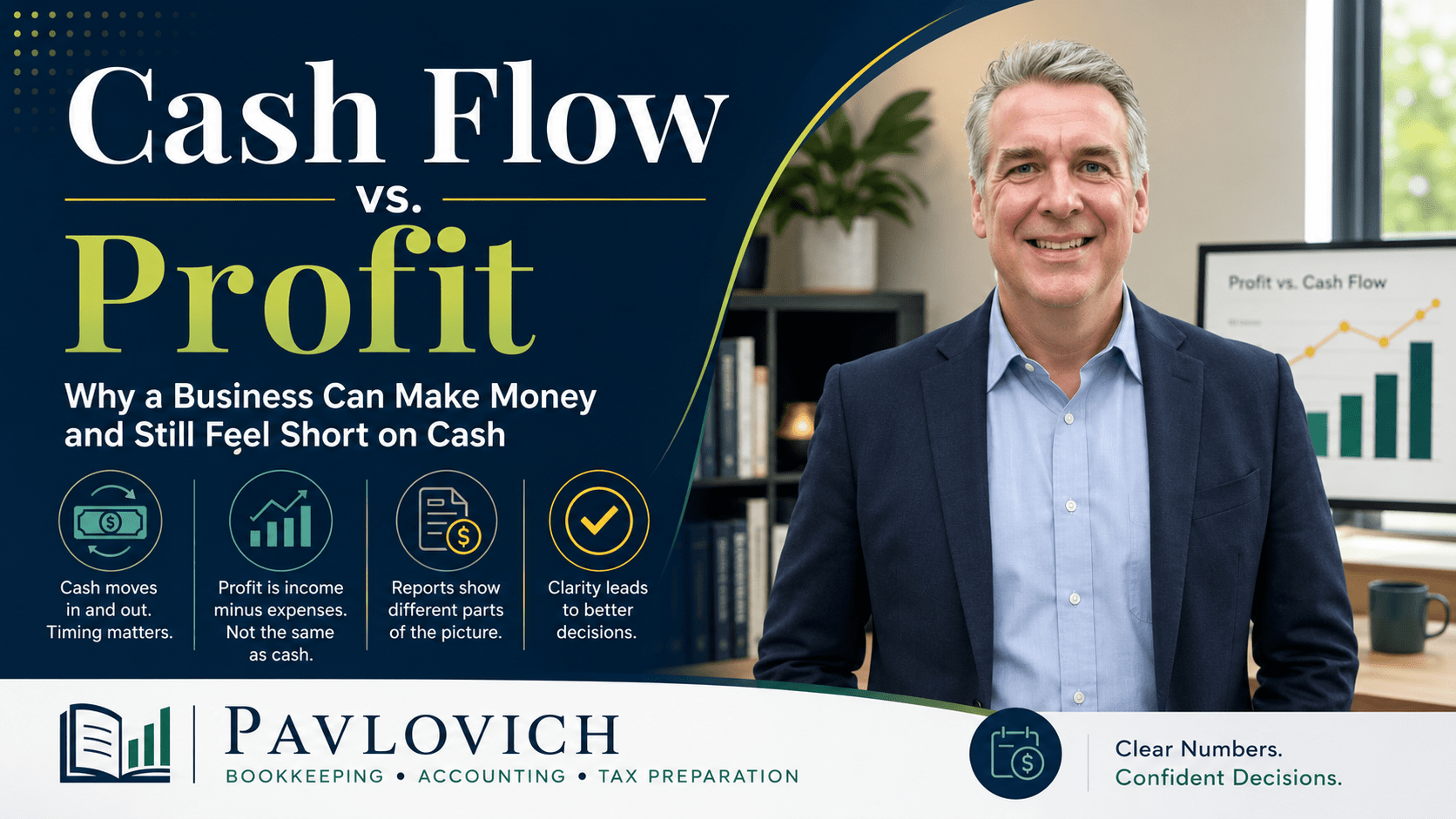
Profit helps you understand whether the business earned more than it spent during a specific period. Cash flow shows how money actually moved into and out of the business.
Small business owners need both perspectives. When you understand the difference between cash flow and profit, you can ask better questions, recognize financial pressure earlier, and make decisions with more confidence.
What Is Profit?
Profit measures the financial result of your business activity over a specific period.
Your profit and loss statement—also called an income statement or P&L—generally shows:
- Revenue
- Cost of goods sold or direct costs
- Gross profit
- Operating expenses
- Other income and expenses
- Net profit or loss
When revenue exceeds the expenses recorded for the period, the business reports a profit. When expenses exceed revenue, the report shows a loss.
The U.S. Securities and Exchange Commission explains that an income statement shows how much money a company earned and spent during a particular period. Although small businesses may use less complex reports than publicly traded companies, the basic purpose remains the same: the report measures financial performance over time. (SEC)
Profit helps answer questions such as:
- Did the business earn more than it spent?
- Are sales covering operating expenses?
- Did profitability improve compared with last month?
- Are direct costs rising faster than revenue?
- Which expenses changed significantly?
- Is the business model producing a reasonable return?
Those questions matter, but the P&L does not explain every movement in your bank account.
What Is Cash Flow?
Cash flow tracks money entering and leaving the business.
Cash may come in through:
- Customer payments
- Cash sales
- Owner contributions
- Loan proceeds
- Asset sales
- Refunds or reimbursements
Money may leave through:
- Payroll
- Contractor payments
- Rent
- Utilities
- Supplies
- Loan payments
- Equipment purchases
- Taxes
- Owner draws
- Credit card payments
The SEC describes the cash flow statement as a report that shows exchanges of money between a company and the outside world during a period. (SEC)
Cash flow helps answer a different set of questions:
- Did available cash increase or decrease?
- Where did money come from?
- What used the most cash?
- Can the business cover upcoming obligations?
- Are customers paying quickly enough?
- Did debt payments or equipment purchases reduce cash?
- Are owner withdrawals putting pressure on the business?
A company can report a profit without having enough available cash to comfortably meet its next obligations. Likewise, cash can increase during an unprofitable period if the owner contributes money or the business receives loan proceeds.
Why Profit and Cash Flow Do Not Always Match
Profit measures business performance according to accounting records. Cash flow measures the timing and movement of money.
Several transactions affect one measure differently from the other. Understanding those differences helps explain why a strong P&L may not produce a strong bank balance.
Customers Have Not Paid Their Invoices
Consider a consulting firm that completes $30,000 of work in June and sends invoices to its clients.
Under accrual accounting, the business may record that revenue when it earns it, even if the clients will not pay until July or August. The June P&L could show a healthy profit while the bank account remains low.
The IRS explains that accrual-method businesses generally report income when they earn it, regardless of when they receive payment. By comparison, cash-method businesses generally report income when they receive it. (IRS)
Neither method changes the basic cash-flow problem: the business cannot use an unpaid invoice to cover payroll or rent.
Accounts receivable reports help identify:
- Which customers still owe money
- How long invoices have remained unpaid
- Whether payment delays are increasing
- Which balances need follow-up
- How much reported revenue has not yet become cash
A business may appear profitable while carrying a growing amount of unpaid customer invoices. In that case, the problem may involve collection timing rather than sales volume.
The Business Paid Down Loan Principal
A loan payment usually includes principal and interest.
The interest portion generally appears as an expense on the profit and loss statement. Principal repayment reduces the loan balance on the balance sheet instead of appearing as a normal operating expense.
Still, the entire payment leaves the bank account.
Suppose a business makes a $2,000 monthly loan payment consisting of $500 in interest and $1,500 in principal. The P&L may show only the $500 interest expense, while cash decreases by the full $2,000.
That difference does not mean the reports conflict. Each report records a different part of the transaction.
Accurate bookkeeping should separate principal and interest so that:
- Interest expense appears correctly
- The loan balance decreases correctly
- Cash activity matches the bank statement
- The balance sheet remains reliable
- The owner can see the full financial effect of the debt
Recording the entire payment as an expense may understate profit and leave the loan balance incorrect. Recording nothing but the bank withdrawal without reviewing the loan details can create similar confusion.
The Business Purchased Equipment
A contractor may buy tools, a cleaning company may purchase a vehicle, or a consulting firm may replace several computers.
Cash could leave the bank immediately. However, the books may record the purchase as an asset rather than treating the full amount as an ordinary expense on that month’s P&L.
For example, a business could spend $12,000 on equipment. The bank balance drops by $12,000, but the profit and loss statement may not show a matching $12,000 operating expense.
The balance sheet helps explain where the money went because it shows assets, liabilities, and equity at a specific point in time. The cash flow statement provides another perspective by showing cash used for operating, investing, and financing activities. (SEC)
A large purchase can therefore create cash pressure even when the business remains profitable.
Tax treatment and depreciation rules depend on the specific asset and the business’s circumstances. A qualified tax professional should determine how the purchase affects the tax return.
Inventory or Materials Used Cash Before the Sale
Businesses that carry inventory or purchase materials may spend cash well before they receive customer payments.
A retailer might buy seasonal merchandise several months before selling it. Similarly, a contractor may purchase materials before reaching the billing stage of a project.
These purchases reduce available cash immediately. Depending on the accounting method and how the records are maintained, the timing of the expense on the P&L may differ from the timing of the payment.
This gap can become larger when:
- Inventory moves slowly
- Projects take longer than expected
- Customers pay after completion
- Suppliers require early payment
- The business purchases more material than it currently needs
- Sales forecasts do not match actual demand
Strong sales do not automatically create healthy cash flow when money remains tied up in unsold inventory, unfinished projects, or unpaid invoices.
Owner Draws Reduced the Bank Balance
Owner draws generally do not appear as operating expenses on a sole proprietorship’s or certain LLCs’ profit and loss statement. Instead, they affect the owner’s equity.
Cash still leaves the business.
A company might earn a $10,000 monthly profit but distribute $12,000 to the owner. The P&L remains profitable, while the bank balance decreases.
Clear bookkeeping should distinguish owner activity from business expenses. Otherwise, the financial reports may overstate operating costs or make it difficult to understand how much cash the business itself is generating.
Owners should review withdrawals alongside:
- Upcoming payroll
- Vendor bills
- Taxes
- Debt payments
- Seasonal needs
- Planned purchases
- Minimum cash reserves
Bookkeeping can show what happened. Decisions about compensation, distributions, and tax planning may require guidance from a qualified tax professional, CPA, or other appropriate advisor.
Credit Card Purchases and Payments Fell in Different Periods
Credit cards create another timing difference.
A business may record expenses when it makes purchases during one month, then pay the credit card statement during the next month. The P&L reflects the expenses when recorded, while the bank account does not show the cash leaving until payment occurs.
Problems arise when the books record both the original purchases and the credit card payment as expenses. That treatment duplicates costs and can make the P&L unreliable.
The payment should generally reduce the credit card liability rather than create the same expenses again.
Monthly credit card reconciliations help confirm that:
- Purchases appear once
- Payments reduce the card balance
- Credits and refunds appear correctly
- Interest and fees use appropriate categories
- The statement balance matches the books
Without that review, business owners may struggle to explain both profit and cash activity.
Taxes Create Periodic Cash Pressure
A profitable business may need to reserve money for income taxes, payroll taxes, sales taxes, or other obligations.
Some of those amounts do not appear on the P&L as ordinary business expenses. For example, sales tax collected from customers may create a liability because the business holds that money until it sends the amount to the appropriate taxing authority.
Cash can look available even though part of the balance already has a future purpose.
Tax deadlines may also create larger cash outflows during certain months. A business that does not regularly set money aside could feel short on cash when those payments become due, even after reporting several profitable months.
Bookkeeping helps identify the activity, but it does not determine every tax requirement or calculate advanced tax strategies. Business owners should work with an appropriate tax professional when they need guidance about payment amounts, filing obligations, or tax planning.
Seasonal Timing Changed the Bank Balance
Many small businesses do not earn revenue evenly throughout the year.
Landscapers may collect more during warmer months. Event businesses may have busy and quiet seasons. Contractors may experience project delays during winter. Retailers often purchase inventory before their strongest sales periods.
A company can earn a profit for the full year while experiencing short-term cash pressure during slower months.
Seasonality may affect:
- Customer payments
- Payroll needs
- Inventory purchases
- Insurance premiums
- Equipment maintenance
- Tax payments
- Annual subscriptions
- Owner withdrawals
Monthly reports make those patterns easier to recognize. Over time, business owners can compare strong and weak periods instead of treating every low bank balance as an unexpected emergency.
Which Financial Reports Should You Review?
A bank balance provides useful information, but it cannot explain your entire financial position.
The Small Business Administration encourages business owners to maintain accurate financial information and review financial statements when managing their companies. (Small Business Administration)
Several reports work together to explain cash flow and profit.
Profit and Loss Statement
The P&L shows revenue, expenses, and net profit or loss during a period.
Use it to review:
- Sales performance
- Direct costs
- Gross profit
- Operating expenses
- Net profit
- Month-to-month changes
- Year-to-date results
This report explains whether the business earned a profit, but it does not show every cash movement.
Balance Sheet
The balance sheet shows what the business owns, what it owes, and the owner’s equity at a specific date.
Review it for:
- Bank balances
- Accounts receivable
- Credit card balances
- Loans
- Accounts payable
- Equipment and other assets
- Payroll or sales tax liabilities
- Owner contributions and draws
Many cash-flow questions become clearer when you review the balance sheet alongside the P&L.
Cash Flow Statement
The cash flow statement organizes cash movement into three general areas:
- Operating activities
- Investing activities
- Financing activities
Operating activities relate to the company’s primary business operations. Investing activities often include asset purchases and sales. Financing activities may include loans, debt repayment, owner contributions, or distributions.
This report helps explain how the business moved from its beginning cash balance to its ending cash balance.
Accounts Receivable Report
An accounts receivable report shows customer balances that remain unpaid.
It can help you identify:
- Overdue invoices
- Slow-paying customers
- Increasing collection delays
- Revenue that has not become cash
- Balances that may need correction or follow-up
A profitable company with high accounts receivable may need to improve its collection process or payment terms.
Accounts Payable Report
Accounts payable shows bills that the business has received but has not yet paid.
This report helps you anticipate upcoming cash needs rather than relying only on the current bank balance.
A large balance may indicate that:
- Several payments will soon come due
- Expenses have already been recorded without cash leaving
- The current bank balance overstates what is truly available
- Vendor obligations need closer attention
A Practical Cash Flow and Profit Example
Imagine a small service company reports the following activity for one month:
- Revenue earned: $40,000
- Operating expenses: $28,000
- Net profit: $12,000
At first glance, the month looks strong.
However, the business also experienced these cash movements:
- $10,000 of the revenue remains unpaid
- $4,000 went toward loan principal
- $6,000 purchased new equipment
- The owner withdrew $5,000
- A prior month’s customers paid $3,000
Starting with the $12,000 profit does not explain the ending bank balance.
The unpaid invoices reduced the cash collected during the month. Loan principal, equipment, and the owner withdrawal used cash without appearing as regular operating expenses on the P&L. Meanwhile, the $3,000 collection from a prior month increased cash without creating new revenue for the current period.
This example shows why a business owner should not ask only, “Did we make a profit?”
A more useful question is:
What caused cash to increase or decrease, and does that movement make sense based on what happened in the business?
What Should Small Business Owners Review Each Month?
A consistent monthly review helps you connect financial reports with real business activity.
Begin with these questions:
- Have all bank and credit card accounts been reconciled?
- Did the business earn a profit?
- Did available cash increase or decrease?
- Which customers still owe money?
- Are outstanding invoices becoming older?
- Which bills remain unpaid?
- Did the business purchase equipment, inventory, or materials?
- How much cash went toward loan principal?
- Did owner draws or distributions increase?
- Are payroll, tax, or insurance payments approaching?
- Did any unusual transactions affect the month?
- Do the reports match what actually happened?
- Will the business have enough cash for its near-term obligations?
Avoid reviewing each report in isolation. A P&L may reveal an expense increase, while the balance sheet explains a new loan and the cash flow statement shows where the borrowed funds went.
The goal is not simply to collect reports. It is to understand what the reports mean together.
How Organized Bookkeeping Improves Cash Flow Clarity
Bookkeeping does not create profit, collect invoices, or produce cash on its own.
However, organized records help business owners understand what is driving the numbers.
Accurate monthly bookkeeping can help by:
- Keeping income and expenses current
- Reconciling bank and credit card accounts
- Separating loan principal from interest
- Tracking unpaid customer invoices
- Recording outstanding vendor bills
- Distinguishing owner activity from business expenses
- Organizing equipment and asset purchases
- Maintaining reliable financial reports
- Preparing tax-ready records
- Giving the owner better information for professional conversations
When the books remain incomplete, cash pressure can be difficult to diagnose. The business owner may blame low sales when the actual issue involves slow collections, large debt payments, owner withdrawals, or a recent asset purchase.
Reliable reports replace some of that guesswork with clearer information.
Bookkeeping and Accounting Support Serve Different Purposes
Bookkeeping creates the organized records needed for accurate reporting. Accounting support helps the owner interpret those reports and connect them to business activity.
A bookkeeper may confirm that transactions are categorized, accounts are reconciled, and balances match supporting records.
Accounting support goes a step further by helping the owner consider questions such as:
- Why did gross profit change?
- Which expenses increased?
- Why did cash fall during a profitable month?
- Are unpaid customer balances growing?
- Did debt payments create the pressure?
- Does the business need to prepare for a seasonal slowdown?
- Which issues should the owner discuss with a CPA, lender, or tax professional?
This support does not replace financial planning, investment advice, complex tax guidance, or CPA services. Instead, it gives the business owner organized information and a stronger starting point for decisions and professional conversations.
Do Not Rely on the Bank Balance Alone
Your bank balance tells you how much cash sits in the account at that moment. It does not tell you:
- Which bills remain unpaid
- How much customers still owe
- Whether sales produced a profit
- How much cash belongs to future tax obligations
- Whether credit card balances are growing
- How much debt the business carries
- Whether owner withdrawals are sustainable
- Which expenses changed
- Whether the books contain errors
A high bank balance does not automatically mean the business is profitable. Loan proceeds, owner contributions, or delayed vendor payments can temporarily increase cash.
Likewise, a low balance does not automatically mean the business is losing money. The company may have purchased equipment, paid down debt, or be waiting for customers to pay invoices.
Use the bank balance as one piece of information—not the complete financial picture.
When Cash Flow Questions Need Additional Help
Some cash-flow concerns fall outside normal bookkeeping and reporting support.
Consider consulting an appropriate professional when you need help with:
- Complex tax questions
- Tax-payment planning
- Financing options
- Loan restructuring
- Legal obligations
- Insolvency concerns
- Investment decisions
- Long-term financial planning
- Complex business structures
- Audited or reviewed financial statements
Pavlovich Bookkeeping & Accounting is not a CPA firm and does not provide audits, attest services, investment advice, or financial planning.
Our role is to help small business owners maintain organized financial records, receive clearer reports, and better understand where their business stands. When another professional needs to become involved, reliable books give that person better information to work with.
Profit Tells You How the Business Performed. Cash Flow Tells You What Happened to the Money.
Profit and cash flow answer different questions.
Your profit and loss statement helps show whether revenue exceeded expenses. Cash flow explains how money moved through operations, purchases, debt, owner activity, and other transactions.
A profitable business can still feel short on cash because customers have not paid, equipment required a large investment, debt payments used available funds, or owner withdrawals reduced the bank balance. Seasonal timing, inventory, taxes, and unpaid bills can widen the gap.
Reviewing the P&L, balance sheet, cash flow statement, receivables, and payables together gives you a more complete financial picture.
Pavlovich Bookkeeping & Accounting helps small business owners make sense of their numbers through organized bookkeeping, practical accounting support, clear financial reporting, and tax-ready financial records. Schedule a consultation to discuss how we can help you understand both your profit and your cash flow.