Key Takeaways
- Cash vs accrual bookkeeping affects how income and expenses appear on financial reports.
- Cash-basis bookkeeping records transactions based on actual cash movement, while accrual-basis bookkeeping records when income is earned or expenses are incurred.
- Accrual accounting provides a clearer view of performance but requires careful management of accounts receivable and payable.
- Understanding both methods helps business owners monitor cash flow and prepare accurate financial reports.
- Clean bookkeeping is essential regardless of the accounting method chosen, ensuring accurate financial representation.
Cash vs. accrual bookkeeping can make the same business activity look very different on a financial report. A business owner may review the bank balance, unpaid invoices, vendor bills, and profit and loss statement only to find that the numbers do not seem to agree.
That difference does not necessarily mean the books contain an error. Often, the accounting method determines when income and expenses appear.
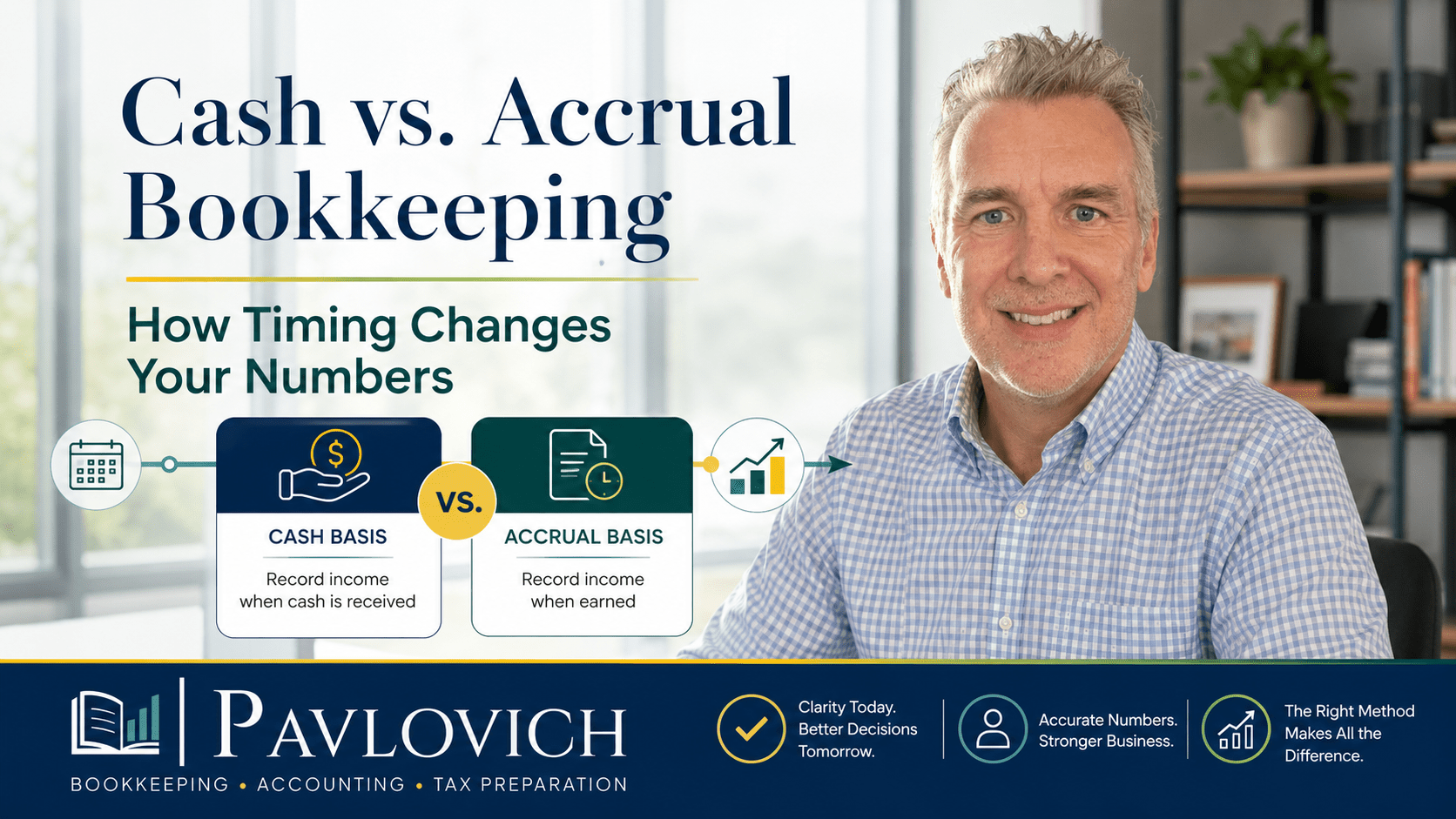
Cash-basis bookkeeping focuses mainly on when money moves. Accrual-basis bookkeeping focuses on when the business earns income or incurs an expense. Understanding that distinction helps you read financial reports more confidently, monitor cash flow, and maintain tax-ready records.
What Is Cash-Basis Bookkeeping?
Cash-basis bookkeeping generally records income when your business receives payment and expenses when your business pays them.
Imagine that a consultant completes a $3,000 project in March but receives the client’s payment in April. Under the cash method, the income generally appears in April because that is when the business receives the money.
Now suppose the consultant receives a $700 subcontractor bill in March and pays it in April. Cash-basis records generally show the expense in April because the payment occurred during that month.
The IRS explains that cash-method taxpayers generally include income when they actually or constructively receive it. They usually deduct business expenses when they pay them, although exceptions can apply to prepaid expenses, assets, and other transactions. (IRS)
Many small service businesses find the cash method easier to follow because it often feels similar to activity in the bank account. Money arrives, so the books show income. Money leaves, so the books show an expense.
However, cash-basis reports do not always show when the business performed the work or used the goods or services. Customer payment delays and the timing of large bills can make one month appear unusually strong or weak.
What Is Accrual-Basis Bookkeeping?
Accrual-basis bookkeeping generally records income when the business earns it and expenses when the business incurs them, even when payment happens later.
Using the same example, the consultant completed the $3,000 project in March and received payment in April. Under the accrual method, the business may record the income in March because it earned the revenue during that month.
Likewise, the $700 subcontractor bill may appear as a March expense if the subcontractor completed the work in March, even though the consultant did not pay the bill until April.
Accrual accounting can connect income and related expenses more closely to the period in which the business activity occurred. As a result, it may provide a clearer view of monthly performance for businesses that invoice customers, receive vendor bills, or manage longer projects.
Exact tax timing under the accrual method can involve additional rules. The IRS generally requires accrual-method taxpayers to recognize income when the events establishing the right to receive it have occurred and the amount can be determined with reasonable accuracy. Expense timing may also depend on when the liability becomes fixed and when economic performance occurs. (IRS)
Cash vs. Accrual Bookkeeping at a Glance
| Business activity | Cash-basis treatment | Accrual-basis treatment |
|---|---|---|
| Customer invoice | Income generally appears when the customer pays | Income may appear when the business earns it |
| Vendor bill | Expense generally appears when the business pays | Expense may appear when the business incurs it |
| Unpaid customer balance | Usually does not appear as income on a cash-basis profit and loss statement | Usually appears in accounts receivable |
| Unpaid vendor balance | Usually does not appear as an expense on a cash-basis profit and loss statement | Usually appears in accounts payable |
| Main timing question | When did the money move? | When did the business activity occur? |
Neither method automatically produces better bookkeeping. Each method answers a different question, and both depend on accurate, consistent records.
A Simple Cash vs. Accrual Example
Consider a small cleaning company that completes a commercial project on March 25. The company sends a $5,000 invoice on March 28, and the customer pays on April 15.
The company also receives a $1,200 bill for temporary labor used on the project. That bill arrives in March but gets paid in April.
Under cash-basis bookkeeping:
- The $5,000 of income generally appears in April.
- The $1,200 expense generally appears in April.
- March may not show the financial effect of the project.
Under accrual-basis bookkeeping:
- The $5,000 of income may appear in March.
- The $1,200 expense may appear in March.
- March reports may show the project’s revenue and related labor cost together.
The work happened in March, while the cash moved in April. Both sets of reports can be accurate, but they describe the timing differently.
Why Your Bank Balance Does Not Equal Your Profit
A bank balance and a profit figure measure different things.
Your bank balance shows the cash available in an account at a particular moment. In contrast, a profit and loss statement shows income minus expenses over a selected period using the accounting basis applied to the report.
A business can report a profit while experiencing limited cash flow. For example, customers may owe the business money, loan payments may reduce available cash, or the owner may have withdrawn funds.
The reverse can also happen. A company may have cash in the bank without generating strong profit. That cash might come from a business loan, owner contribution, transfer between accounts, customer deposit, or another source that does not represent earned revenue.
Consequently, the bank balance alone cannot explain the business’s full financial position. A useful financial review may also include:
- The profit and loss statement
- The balance sheet
- Accounts receivable
- Accounts payable
- Loan balances
- Owner contributions and draws
- Transfers between accounts
- Cash flow activity
Organized bookkeeping creates the foundation for these reports. Accounting support helps the owner understand how the pieces fit together.
How Accounts Receivable Affect Accrual Reports
Accounts receivable represents money that customers owe your business.
Suppose an electrician completes several projects in June and sends $20,000 in invoices. Customers do not pay $8,000 of those invoices until July.
An accrual-basis June profit and loss statement may include the full $20,000 of earned revenue. Meanwhile, the unpaid $8,000 generally appears as accounts receivable on the balance sheet.
Although the business reports the revenue, it cannot spend the unpaid portion yet. Therefore, strong accrual-basis income does not always mean the company has strong cash flow.
Reviewing accounts receivable can help an owner answer practical questions:
- How much money do customers still owe?
- Which invoices have become overdue?
- How long does the business usually wait for payment?
- Are late payments creating cash flow pressure?
- Does the reported revenue regularly turn into cash?
Accurate invoice and payment matching matters because an unreliable accounts receivable balance can make both the profit and loss statement and balance sheet harder to trust.
How Accounts Payable Affect Accrual Reports
Accounts payable represents bills that the business owes but has not yet paid.
For example, a landscaping company may receive $6,000 in material and subcontractor bills near the end of May. If the company pays those bills in June, a cash-basis May report generally will not include the expenses.
An accrual-basis May report may show the expenses in May, while the unpaid balances appear in accounts payable.
That distinction matters because cash in the bank does not always represent money that the business can freely use. Some of it may already be needed for vendor bills, payroll obligations, sales tax payments, loan payments, or other upcoming costs.
Regular accounts payable review helps a business owner understand:
- Which bills remain unpaid
- When payments come due
- Whether expenses belong to the correct reporting period
- How upcoming obligations may affect cash
- Whether vendor records agree with the books
Which Method Gives You Better Financial Reports?
The better method depends on what you need the reports to explain.
Cash-basis reports may work well for a business with straightforward transactions, immediate customer payments, and few unpaid bills. Many sole proprietors and small service businesses appreciate the method’s simplicity.
Accrual-basis reports may provide more useful information when a business:
- Sends invoices before receiving payment
- Gives customers time to pay
- Receives bills before paying vendors
- Manages several ongoing projects
- Collects retainers or deposits
- Tracks accounts receivable and accounts payable
- Needs to compare project income with related costs
- Wants stronger month-to-month performance reporting
For management purposes, an accrual view can help connect business activity to the period when it occurred. However, the owner must still monitor cash because accrual income does not guarantee that customer payments have arrived.
Good reporting goes beyond selecting a basis. The reports must also contain accurate transactions, properly matched payments, reconciled accounts, and clearly recorded balance-sheet activity.
Why Consistency Matters
Reports become less useful when a business applies timing rules inconsistently.
Suppose one month records revenue when the business sends invoices, while the next month records revenue only when customers pay. A comparison between those months could suggest that sales rose or fell even though the bookkeeping method caused the difference.
Consistent records help business owners:
- Compare financial performance between periods
- Identify meaningful revenue and expense trends
- Understand changes in profit
- Maintain clearer accounts receivable and payable balances
- Prepare more dependable information for a tax preparer or CPA
- Reduce confusion during tax season
The IRS requires businesses to use an accounting method that clearly reflects income. A business generally selects its method when it files its first return for the activity, and changing that method may require IRS approval. (IRS)
How the Accounting Method Affects Tax Preparation
The accounting method can affect the tax year in which a business reports income or deducts expenses.
Schedule C asks sole proprietors to identify whether they use the cash, accrual, or another permitted method. The IRS generally allows these methods when they clearly reflect income, although inventory, long-term contracts, and other situations may require additional consideration. (IRS)
Businesses should not switch between cash and accrual treatment casually. In many cases, changing an established accounting method requires Form 3115 and an adjustment designed to prevent income or expenses from being counted twice or omitted. (IRS)
Your bookkeeper can maintain organized records using the method applied to your books. A qualified tax preparer or CPA should help determine which method applies to your return, particularly when the business has inventory, long-term contracts, complex entity structures, or specialized tax issues.
Inventory and Other Situations Need Additional Review
Inventory can make the cash-versus-accrual decision more complicated.
Businesses that produce, purchase, or sell merchandise generally must account for inventory. Certain qualifying small business taxpayers may use simplified inventory treatment, but they must still use a method that clearly reflects income. (IRS)
Other transactions can also require careful review:
- Customer deposits
- Retainers
- Prepaid expenses
- Long-term projects
- Large equipment purchases
- Loan proceeds and payments
- Deferred revenue
- Related-party transactions
- Uncollectible customer balances
A deposit in the bank does not always represent earned income. Similarly, a payment does not always create an immediate expense. The transaction’s purpose, timing, and documentation determine how it should flow through the books.
Questions to Ask Before Choosing or Reviewing a Method
Before relying on cash- or accrual-basis reports, consider how your business operates.
Ask:
- Do you invoice customers before they pay?
- How long do customers usually take to pay?
- Do vendors send bills that you pay later?
- Does the business carry inventory?
- Do you accept retainers or customer deposits?
- Are projects completed across several reporting periods?
- Do you need financial statements for a lender or lease?
- Are you trying to compare current performance with prior months?
- Which accounting method does the business use for tax reporting?
- Has the business applied that method consistently?
- Would a proposed change require tax guidance or IRS approval?
These questions help determine what your reports show and what additional information you may need before making a decision.
Clean Bookkeeping Supports Either Method
Cash and accrual methods both depend on reliable bookkeeping.
Changing the accounting basis will not correct:
- Missing transactions
- Unreconciled bank accounts
- Duplicate income
- Uncategorized expenses
- Unmatched invoice payments
- Incorrect vendor bills
- Personal purchases in business accounts
- Misclassified loans or transfers
- Unclear owner draws and contributions
Monthly reconciliations confirm that the bookkeeping records agree with the bank and credit card statements. Proper categorization helps the profit and loss statement describe business activity accurately. Meanwhile, balance-sheet review helps identify unpaid invoices, outstanding bills, loans, transfers, and other items that do not belong on the profit and loss statement.
Once the records are organized, financial reporting becomes more useful. Instead of simply seeing totals, business owners can understand what happened, why the numbers changed, and what deserves attention next.
How Pavlovich Bookkeeping & Accounting Helps
Pavlovich Bookkeeping & Accounting helps small business owners make sense of their numbers through organized bookkeeping, practical accounting support, and clear financial reporting.
Our work may include monthly bookkeeping, catch-up bookkeeping, bookkeeping cleanup, account reconciliations, QuickBooks support, and tax-ready financial records. We also help clients review financial reports so they can understand why profit, cash, unpaid invoices, and upcoming bills may tell different parts of the story.
For qualifying clients, our firm provides personal tax preparation and limited small business tax preparation for sole proprietors, small LLCs, and similar straightforward businesses. Pavlovich Bookkeeping & Accounting is not a CPA firm. Businesses with audits, complex tax matters, advanced tax planning needs, or specialized accounting issues may need support from a CPA or another qualified professional.
Clear Timing Leads to Clearer Financial Understanding
Cash-basis bookkeeping asks when money moved.
Accrual-basis bookkeeping asks when the business earned income or incurred an expense.
Once you understand that timing difference, financial reports become easier to interpret. Unpaid invoices may explain why reported income looks strong while cash remains limited. Outstanding vendor bills may show why a healthy bank balance does not tell the whole story.
The accounting method matters, but accurate records matter just as much. Organized books, consistent reporting, and regular financial review give you a clearer picture of where your business stands.
Need help understanding why your income, expenses, profit, and bank balance do not seem to line up? Schedule a consultation with Pavlovich Bookkeeping & Accounting to discuss your bookkeeping and accounting support needs.