Key Takeaways
- A small business recordkeeping system should efficiently organize financial data, support consistent reports, and facilitate tax preparation.
- Scattered records complicate bookkeeping as businesses grow; a structured approach is essential.
- Important documents include invoices, receipts, bank statements, and payroll records; clear categorization enhances financial clarity.
- A monthly routine for recordkeeping helps track changes and supports accurate financial reporting.
- Keeping business and personal transactions separate improves record accuracy and simplifies bookkeeping.
A small business recordkeeping system should do more than give receipts and statements a place to live. It should help you keep your books organized, understand what happened in your business, prepare useful financial reports, and stay ready for tax preparation.
Many business owners save documents without creating a real system. Receipts collect in email inboxes. Bank statements sit in online portals. Contractor forms end up in separate folders. Important details may live in text messages, handwritten notes, or someone’s memory.
That approach can work for a while. As the business grows, however, scattered records make bookkeeping harder and financial reports less reliable.
A practical recordkeeping system creates a repeatable process for collecting, organizing, reviewing, and using financial information. The IRS allows businesses to use a recordkeeping system that fits their needs as long as the system clearly shows income and expenses. It also notes that good records can help business owners monitor progress, prepare financial statements, identify income sources, track expenses, prepare tax returns, and support information reported on those returns. (IRS)
The goal is not to save every document without a plan. Instead, build a system that gives your bookkeeping and accounting records enough context to help you understand your numbers.
Why a Small Business Recordkeeping System Matters
Every financial transaction tells part of the story of your business. A bank feed may show that money moved, but it does not always explain why.
Consider a $5,000 deposit. Depending on the circumstances, that money could represent:
- Customer revenue
- A loan
- An owner contribution
- A transfer between business accounts
- A refund
- A reimbursement
The amount alone does not tell you how the transaction should appear in your books.
Expenses create similar questions. A single purchase from a hardware store could include materials for a customer project, tools, equipment, cleaning supplies, or personal items. Without supporting details, even a familiar vendor name may not provide enough information to categorize the transaction correctly.
That is why organized records matter beyond tax season. They support monthly bookkeeping, account reconciliations, financial reporting, cash flow review, bookkeeping cleanup, and conversations with your tax preparer or CPA.
The U.S. Small Business Administration emphasizes the importance of proper bookkeeping and a basic understanding of business finances. Financial records become more useful when they help business owners track what the business owns, what it owes, how money moves, and how the company is performing. (Small Business Administration)
A strong recordkeeping system creates the foundation for that understanding.
What Should a Small Business Recordkeeping System Accomplish?
A good system should make four things easier.
First, it should help you capture financial information before details disappear.
Second, it should give each record a clear place to go.
Third, it should support accurate bookkeeping and account reconciliation.
Finally, the system should help turn organized records into financial information you can actually use.
Saving documents matters, but organization alone is not the final goal. The real value comes from connecting those records to your books and reports.
For example, an organized invoice can help explain a customer payment. A loan agreement can help separate principal from interest. A detailed equipment invoice can help identify an asset purchase instead of treating the entire amount like an ordinary operating expense.
When your records provide that context, your bookkeeping can tell a clearer story about the business.
What Counts as a Business Record?
A business record includes a document, report, statement, digital file, or other information that supports a business transaction or financial activity.
Common records include:
- Customer invoices
- Sales receipts
- Deposit details
- Payment processor reports
- Bank statements
- Credit card statements
- Vendor bills
- Purchase receipts
- Paid invoices
- Loan agreements
- Payroll reports
- Contractor records
- Forms W-9 and applicable Forms 1099
- Mileage records
- Equipment and asset purchase documents
- Owner contribution and draw records
- Tax documents
The IRS identifies documents such as sales slips, paid bills, invoices, receipts, deposit information, account statements, and other proof of payment as common forms of supporting documentation. Those records help support entries in the books and information reported on tax returns. (IRS)
Not every business needs the same documents. A contractor may need detailed job-related purchase records, while a consultant may rely more heavily on invoices, payment processor reports, software subscriptions, and travel documentation.
Your recordkeeping system should reflect how your business actually operates.
Start by Separating Business and Personal Activity
One of the simplest ways to improve recordkeeping is to create a clear separation between business and personal transactions.
A dedicated business checking account gives you a cleaner starting point for tracking business activity. Business credit cards can provide similar separation when used consistently for business purchases.
Even with separate accounts, occasional mistakes happen. A business owner may use a personal card for a business expense or accidentally put a personal purchase on a business card.
Do not hide or ignore those transactions. Document them clearly.
For a business purchase paid personally, keep the receipt and note the business purpose. For a personal expense paid through the business, identify it correctly so your books do not treat it as an ordinary business expense.
The goal is not perfection. Clear documentation makes unusual transactions easier to understand and record correctly.
Build a Simple System for Income Records
Income records should explain both how much money the business received and where the money came from.
Depending on the business, useful income records may include:
- Customer invoices
- Sales receipts
- Point-of-sale reports
- Payment processor reports
- Deposit details
- Customer payment confirmations
- Cash receipt logs
- Forms 1099 received by the business
The IRS notes that businesses should keep supporting information showing the amount and source of gross receipts. (IRS)
For bookkeeping purposes, your system should also help answer practical questions.
Was a deposit entirely customer revenue?
Did a payment processor deduct fees before sending the deposit?
Did several customer payments arrive as one batch?
Was the money actually a transfer from another business account?
Could the deposit represent a loan, owner contribution, refund, or reimbursement?
A bank deposit does not always equal income. Good records help distinguish one type of transaction from another.
That distinction matters because inaccurate income records can affect your profit and loss statement, balance sheet, cash flow reporting, and tax preparation.
Keep Enough Detail for Business Expenses
Expense tracking requires more than knowing where you spent money.
A bank or credit card statement may show the vendor, date, and amount. However, it may not show what you purchased or why the purchase related to the business.
That missing detail matters.
The IRS states that supporting documents for business expenses should generally help identify information such as the payee, amount paid, proof of payment, date, and the item or service connected to the business expense. In some situations, more than one document may be necessary to support the full transaction. (IRS)
For example, imagine a $327 charge at a large retailer.
The purchase might include:
- Office supplies
- Cleaning products
- Tools
- Equipment
- Materials for a customer job
- Personal household items
The credit card statement confirms that the payment happened. The itemized receipt explains what the business actually purchased.
Together, those records give your bookkeeping more useful information.
A practical expense recordkeeping system should make it easy to save receipts while the purchase is still fresh in your mind. When the business purpose is not obvious, add a short note rather than relying on memory months later.
Give Payroll and Contractor Records Their Own Process
Payroll and contractor records deserve more attention than a general folder labeled “expenses.”
Employee records may include:
- Payroll reports
- Wage information
- Payroll tax payment confirmations
- Filed payroll tax forms
- Benefit records
- Time records
- Reimbursement documentation
- Year-end wage forms
The IRS currently instructs employers to keep employment tax records for at least four years. (IRS)
Contractor records may include:
- Form W-9
- Invoices
- Agreements
- Payment records
- Contact information
- Applicable year-end tax forms
Collecting contractor information when the relationship begins is usually easier than trying to locate missing information at year-end.
A monthly process also helps. Reviewing contractor payments throughout the year gives you an opportunity to identify missing documentation before January arrives.
Keep Loan Records Separate From Ordinary Expenses
Loan payments often create bookkeeping problems because one payment can contain more than one financial component.
For example, a loan payment may include:
- Principal
- Interest
- Fees
Those amounts may not all appear in the same place on your financial reports.
Keep the original loan agreement, payment schedule, lender statements, interest information, and payoff documents together. That information helps your bookkeeping track the liability and related costs more accurately.
Without supporting records, a recurring loan payment may look like an ordinary expense even though part of the payment reduces a balance sheet liability.
Organized loan records help your books reflect what actually happened.
Create a Dedicated System for Assets and Equipment
Large purchases may need more documentation than ordinary day-to-day expenses.
Examples can include:
- Vehicles
- Computers
- Machinery
- Furniture
- Tools
- Major equipment
- Certain property improvements
The IRS explains that asset records may need to show information such as when and how an asset was acquired, its purchase price, improvement costs, how the business used it, and details about its eventual sale or disposal. (IRS)
Because these records may remain relevant for years, do not treat them like ordinary receipts that can disappear into a monthly expense folder.
Keep purchase invoices, financing documents, trade-in information, improvement records, and sale documents together.
Doing so gives your bookkeeper, tax preparer, or CPA better information when the transaction needs additional review.
Use a Digital Folder Structure That You Can Maintain
A sophisticated recordkeeping system is not automatically a better one.
The best system is one you can use consistently.
For many small businesses, a simple digital folder structure works well:
2026 Business Records
- Income
- Expenses
- Bank Statements
- Credit Card Statements
- Payroll
- Contractors
- Loans
- Assets and Equipment
- Tax Documents
- Business Documents
You can organize further by month, vendor, customer, or account when the volume of records makes that useful.
For example:
Expenses → 2026 → July
or
Bank Statements → Business Checking → 2026
Consistency matters more than creating the perfect folder structure.
Use clear file names as well. A file called 2026-07-08 Home Depot Job Materials.pdf provides more information than scan0047.pdf.
The IRS allows businesses to use electronic recordkeeping systems, provided the records meet the same basic recordkeeping requirements that apply to paper records. (IRS)
Digital storage can make documents easier to search and share, but a folder full of unnamed files can become just as difficult to manage as a drawer full of paper.
Do Not Let Software Become the Entire System
Accounting software can help organize financial information, but software does not automatically create accurate books.
Bank feeds may import transactions. Rules may suggest categories. Receipt tools may store documents.
Someone still needs to review what happened.
A transaction may need clarification because:
- A transfer looks like income.
- A loan payment includes principal and interest.
- A deposit combines several customer payments.
- A purchase includes both business and personal items.
- A payment processor deducted fees before the deposit reached the bank.
- An equipment purchase belongs on the balance sheet rather than among ordinary operating expenses.
Technology can make recordkeeping more efficient. Human review gives the information context.
That is an important distinction for business owners who want more than a list of categorized transactions. Clean bookkeeping should support reliable financial reports and a clearer understanding of where the business stands.
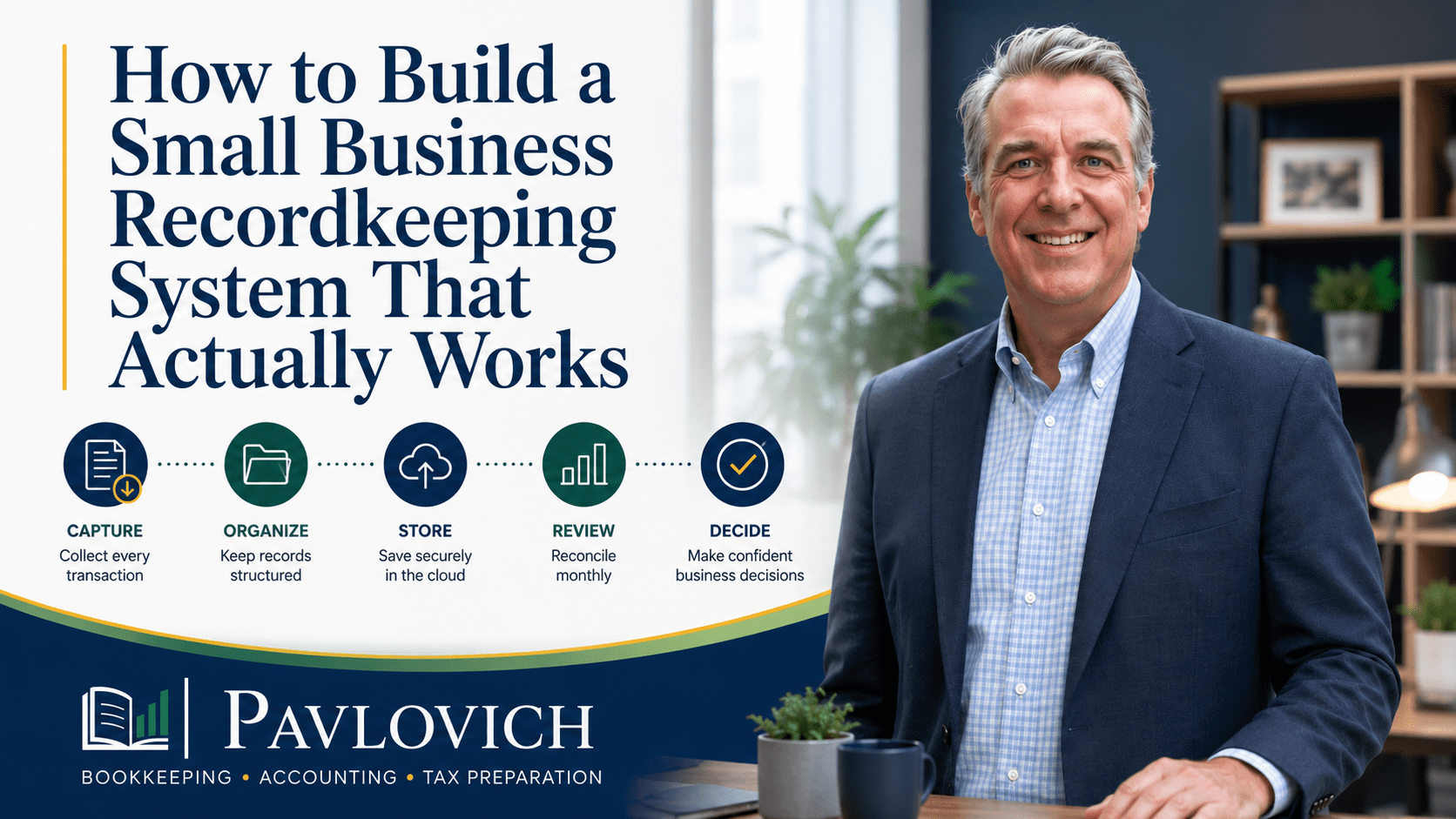
Create a Monthly Recordkeeping Routine
Waiting until tax season to organize an entire year of records can make bookkeeping much harder than it needs to be.
A monthly routine spreads the work across the year.
A practical process might look like this:
1. Gather missing records
Collect receipts, invoices, statements, payroll reports, contractor documents, and other supporting information from the month.
2. Review unusual transactions
Add context to transfers, large purchases, cash transactions, owner payments, loans, refunds, reimbursements, and other activity that may not be obvious.
3. Reconcile financial accounts
Compare the bookkeeping records with bank and credit card statements to confirm that the activity matches.
4. Resolve questions while details are still fresh
A transaction from last week is usually easier to explain than one from eleven months ago.
5. Review the financial reports
Once the books are current, look beyond the transaction list.
Reviewing the profit and loss statement, balance sheet, and cash flow information can help you understand what changed during the month. The SBA highlights proper bookkeeping and financial understanding as important parts of managing a business. (Small Business Administration)
This final step is where recordkeeping becomes more valuable.
Organized documents support bookkeeping. Current bookkeeping supports financial reporting. Clear reports help business owners make better decisions.
Connect Records to Your Financial Reports
A recordkeeping system should eventually help you answer business questions.
For example:
- Is revenue increasing or decreasing?
- Which expenses changed this month?
- Why does the business show a profit but feel short on cash?
- How much do customers still owe?
- What does the business owe to lenders or vendors?
- Did a large equipment purchase affect cash without becoming an ordinary monthly expense?
- Are the books ready to share with a tax preparer or CPA?
Financial reports depend on the information behind them.
A profit and loss statement can only tell a useful story when income and expenses are recorded appropriately. The balance sheet becomes harder to trust when loans, owner activity, assets, or transfers are recorded incorrectly.
That is why good recordkeeping is not separate from accounting support. It creates the foundation for it.
Know How Long to Keep Business Records
There is no single retention period that applies to every business document.
The IRS explains that the length of time a business should keep a record depends on the action, expense, or event the document supports. Records generally need to remain available as long as necessary to support income, deductions, or other information on a tax return. (IRS)
Some records require special consideration.
Employment tax records, for example, should generally remain on file for at least four years. Asset and property documentation may need to be retained longer because the information can remain relevant until after the business disposes of the property. (IRS)
Before deleting older records, consider whether they may still matter for:
- Tax purposes
- Loans
- Insurance claims
- Contracts
- Payroll
- Property or equipment
- State requirements
- Business disputes
For questions about a specific retention period or complex tax situation, consult an appropriate tax professional, CPA, attorney, or other qualified adviser.
Common Recordkeeping Mistakes That Make the Books Harder to Trust
Most recordkeeping problems begin with small habits.
Common examples include:
- Mixing business and personal transactions
- Relying only on bank feeds
- Saving receipts without matching them to purchases
- Forgetting to document cash transactions
- Failing to save payment processor reports
- Using vague file names
- Waiting until year-end to collect contractor information
- Losing loan or equipment records
- Ignoring old unreconciled transactions
- Waiting until tax season to organize the entire year
Each issue may seem minor on its own. Repeated over several months, however, these habits create unanswered questions.
Eventually, the business owner or bookkeeper may need to reconstruct what happened long after the details have been forgotten.
A consistent monthly system reduces that problem.
What Should You Do If Your Records Are Already Disorganized?
Start with the most important records rather than trying to fix everything at once.
Begin by gathering:
- Bank statements
- Credit card statements
- Income records
- Major purchase documentation
- Loan information
- Payroll and contractor records
- Tax documents
Next, compare what you have with the activity in your bookkeeping system.
Missing months may require catch-up bookkeeping. Incorrect or unreliable records may call for bookkeeping cleanup. Businesses with current books may simply need a better monthly process going forward.
The right starting point depends on the problem.
For example, a business that has not updated its books for eight months needs a different approach from a company that enters transactions every week but has never reconciled its accounts.
Once the records become organized and the books become current, monthly bookkeeping can help keep the same problems from returning.
How Bookkeeping and Accounting Support Fit Into the System
A strong recordkeeping process does not end when documents reach a folder.
Those records should support a larger financial process.
Monthly bookkeeping organizes transactions and reconciles accounts. Financial reporting turns the bookkeeping into statements that show what is happening in the business. Accounting support helps the owner review that information, understand changes, and identify questions that deserve attention.
In other words, bookkeeping creates the foundation.
Financial reporting adds visibility.
Accounting support helps turn that information into understanding.
This process also helps create more organized, tax-ready financial records for a tax preparer or CPA when needed.
Pavlovich Bookkeeping & Accounting is not a CPA firm and does not provide audit or attestation services. However, organized bookkeeping and clear financial records can make it easier for business owners to work with their CPA or other tax professional when specialized support becomes necessary.
Build a Recordkeeping System You Can Actually Use
A small business recordkeeping system does not need to be complicated.
It needs to be consistent.
Give income records, expense documents, statements, payroll information, contractor forms, loan documents, asset records, and tax paperwork a clear place to go. Then create a monthly process for reviewing those records, updating the books, reconciling accounts, and looking at the financial reports.
That routine does more than keep paperwork organized.
It helps you understand what happened in your business, gives your financial reports better support, prepares your records for tax time, and creates a clearer picture of where your business stands.
When your records feel scattered or your books no longer give you reliable information, Pavlovich Bookkeeping & Accounting can help you determine the right place to begin. Schedule a consultation to discuss your current bookkeeping, recordkeeping process, and the support your business may need to get organized and stay informed.