Key Takeaways
- Organized household employee records help families track payments, reimbursements, and schedules, simplifying financial management.
- Families must understand who qualifies as a household employee to determine tax and payroll responsibilities accurately.
- Keep clear distinctions between wages and reimbursements to avoid confusion and ensure accurate recordkeeping.
- Regularly update records and maintain a system that families can use consistently throughout the year to prepare for taxes.
- Consult professionals when unclear on employment classifications, payroll taxes, and necessary documentation related to household employee records.
Hiring regular help at home can make a busy household easier to manage. If you employ domestic workers, it’s also important to understand how to maintain proper household employee records. A nanny may care for children during the week. A housekeeper may help keep the home running. A caregiver may support an aging parent, while a driver or yard worker may provide ongoing help with other responsibilities.
Once those arrangements become recurring, the financial details can become more complicated than a series of payments. Families may need to track hours, wages, reimbursements, schedule changes, bonuses, payroll records, and tax documents. Without an organized system, important details can end up scattered across bank accounts, payment apps, text messages, email, and paper receipts.
Keeping clear household employee records helps families understand what they paid, explain unusual transactions, prepare information for tax or payroll professionals, and avoid rebuilding an entire year of financial activity at tax time.
The goal is not to turn your household into an accounting department. Instead, a consistent recordkeeping system gives you reliable information when questions come up.
Start by Understanding Who May Be a Household Employee
Not everyone who performs work at your home is automatically your household employee.
The IRS generally looks at how much control you have over both the work and how the worker performs it. Household employees may include nannies, housekeepers, caretakers, drivers, health aides, cooks, and certain other workers who perform household services in or around a private home. By contrast, a self-employed worker generally controls how the work is performed, provides their own tools, and offers services to the public as an independent business. An agency may also employ and control a worker rather than the household itself. (IRS)
That distinction matters because worker classification can affect payroll, employment taxes, forms, and recordkeeping responsibilities.
Families should avoid guessing based only on how they pay someone or what they call the arrangement. Paying through a payment app does not determine whether someone is an employee, and calling a worker an independent contractor does not necessarily make that classification correct.
When the situation is unclear, organized records give a CPA, tax preparer, payroll provider, or other qualified professional better information to review.
What Household Employee Records Should Families Keep?
A useful recordkeeping system should answer a few basic questions:
Who performed the work?
When did they work?
How much did you pay?
What did the payment cover?
Did the payment include reimbursements or other amounts?
What payroll or tax documents relate to the worker?
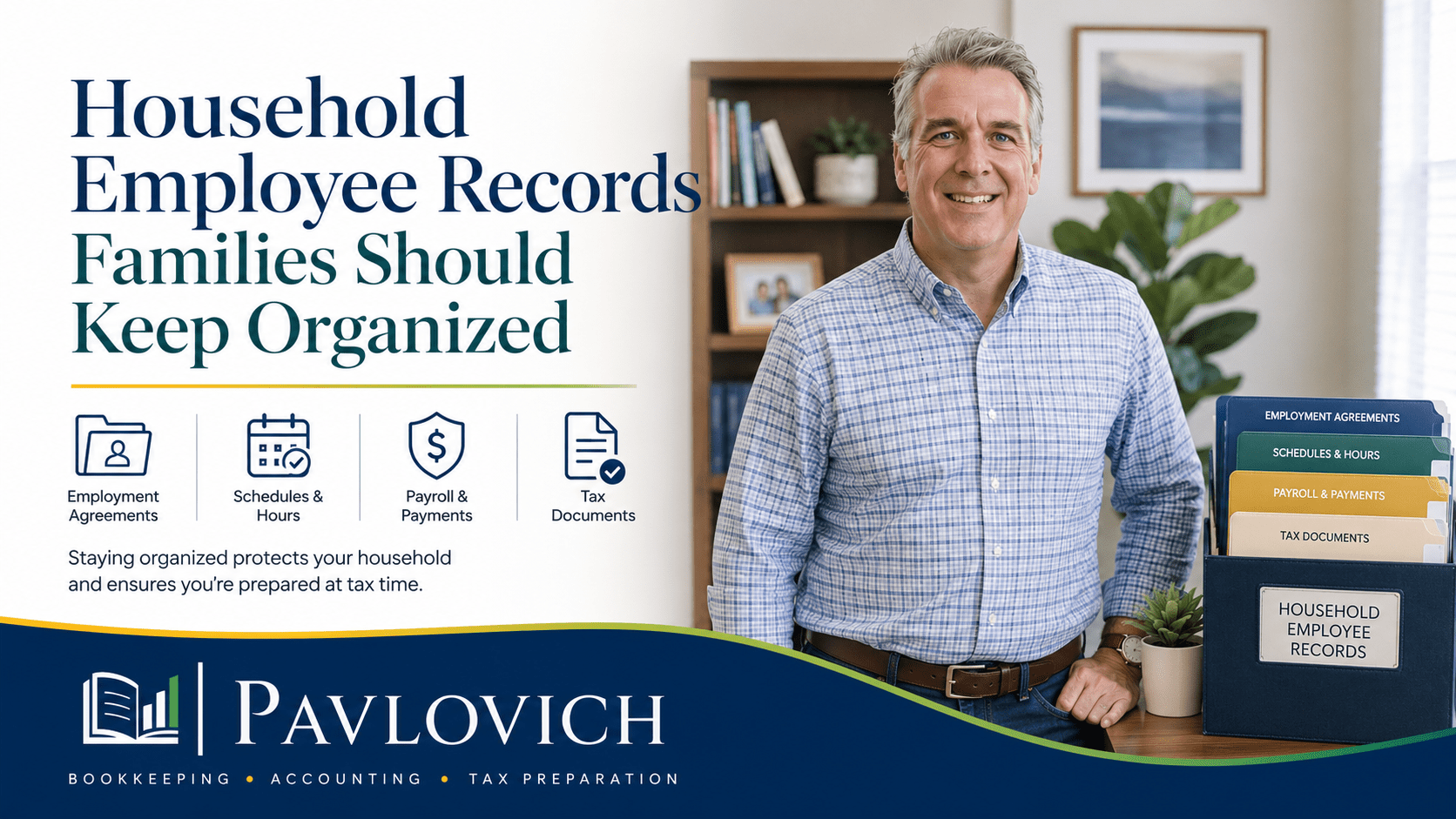
Depending on the arrangement, families may need to keep records such as:
- The worker’s full name and contact information.
- Employment agreements, offer letters, or written descriptions of the arrangement.
- Work schedules and time records.
- Dates and amounts of payments.
- The payment method used.
- Hourly rates, weekly rates, or other compensation details.
- Records of rate changes.
- Bonus or additional compensation records.
- Reimbursement details.
- Receipts for reimbursed household expenses.
- Payroll reports and pay statements.
- Copies of applicable tax and employment forms.
- Records provided to a CPA, tax preparer, or payroll provider.
For domestic service workers covered by federal wage and hour recordkeeping requirements, the U.S. Department of Labor says employers may need to maintain information that includes the worker’s identifying information, hours worked, weekly wages, and certain other payroll details. The exact requirements can depend on the worker and the arrangement. (DOL)
A family may also choose to keep additional notes that make the financial history easier to understand. For example, a calendar showing vacation weeks, schedule changes, or temporary additional duties can explain why one month’s payments differ from another.
Track Hours and Payments Consistently
Regular household help often creates a repeating payment routine. However, repeating payments do not always mean identical payments.
One week may include extra hours. Another may include a bonus. A caregiver’s schedule may change when another family member visits. A nanny may work additional hours during school breaks.
Without clear records, those changes can become difficult to explain later.
A simple payment record might include:
| Date | Worker | Hours | Regular Pay | Other Pay | Reimbursement | Total Paid | Payment Method |
|---|---|---|---|---|---|---|---|
| June 5 | Household helper | 24 | $600 | $0 | $42 | $642 | Bank transfer |
| June 12 | Household helper | 28 | $700 | $50 | $0 | $750 | Bank transfer |
The specific format matters less than consistency. A spreadsheet, payroll system, bookkeeping record, or another organized method can work as long as the family can understand the information later.
The U.S. Department of Labor notes that employers who have recordkeeping responsibilities must keep records of hours worked and wages earned for covered domestic service workers. (DOL)
Even when a family uses a payroll provider, keeping access to reports and supporting records remains important.
Do Not Let Multiple Payment Methods Hide the Full Picture
Household payments often come from more than one place.
One spouse may pay a housekeeper by check. Another may send money through a payment app. An adult child may pay part of a parent’s caregiving expenses. Someone else may reimburse the family later.
Each transaction may make sense when it happens. The problem appears when the family tries to reconstruct the total cost months later.
Suppose a caregiver receives:
- $800 from one family member by check.
- $400 from another family member through a payment app.
- $75 as reimbursement for groceries.
- $30 as reimbursement for parking.
Looking at only one bank account would not show the entire arrangement.
A central record can bring those payments together. It should show who made each payment, who received it, when the payment occurred, and what the amount represented.
This is one reason organized personal bookkeeping can be valuable for households with several accounts or family members sharing financial responsibilities. The purpose is not simply to categorize transactions. It is to create a clearer picture of where the household’s money went.
Keep Wages and Reimbursements Clearly Separated
Reimbursements can make household employee records especially confusing.
A nanny may pay an activity fee while caring for a child. A caregiver may buy groceries or medical supplies for an aging parent. A driver may pay for parking. A household helper may pick up supplies.
When a family combines everything into one payment without keeping supporting notes, it may become difficult to determine how much represented compensation and how much repaid an expense.
For example, a payment of $775 might actually include:
- $700 for work performed.
- $45 for household supplies.
- $30 for parking.
Recording only “$775 paid to caregiver” leaves important information out of the financial record.
Instead, document each part of the payment and keep the related receipts when appropriate. Clear documentation helps the family understand its own spending and gives a tax or payroll professional better information to work with.
Keep Payroll and Tax Records Together
Household employment can create federal and state tax responsibilities, depending on the worker, the amount paid, and the specific facts.
For 2026, the IRS states that paying $3,000 or more in cash wages to one household employee generally triggers Social Security and Medicare tax requirements, subject to specific exceptions. Separate federal unemployment tax rules may also apply, and state requirements can differ. (IRS)
Because thresholds and requirements can change, families should check current guidance rather than relying on a number they remember from a previous year.
The IRS recommends keeping copies of applicable employment tax forms and the records that support the information reported on those forms. Wage and tax records may include the dates and amounts of cash and noncash wages as well as Social Security, Medicare, federal income tax, and state employment taxes withheld or paid when applicable. (IRS)
A household employment file may therefore include:
- Payroll reports.
- Wage summaries.
- Forms W-2 and W-3 when applicable.
- Schedule H when applicable.
- Federal and state tax records.
- Records of taxes withheld or paid.
- Employment eligibility documentation when required.
- Correspondence with a payroll provider or tax professional.
Keeping these documents together makes year-end preparation easier and gives the family a more complete financial history.
Use a Recordkeeping System You Can Maintain All Year
The best system is not necessarily the most complicated one. It is the one the household will actually use.
A practical digital folder structure might look like this:
Household Employees
- 2026
- Worker A
- Agreement and employment documents
- Time records
- Payment records
- Reimbursements and receipts
- Payroll reports
- Tax documents
- Worker B
- Agreement and employment documents
- Time records
- Payment records
- Reimbursements and receipts
- Payroll reports
- Tax documents
- Worker A
Families can also maintain a summary spreadsheet that shows payments throughout the year while storing supporting documents separately.
A good routine may include:
- Recording hours and payment details each pay period.
- Separating compensation from reimbursements.
- Saving receipts and supporting documents.
- Reviewing the records monthly.
- Making sure payroll or tax documents remain accessible.
- Providing organized information to the appropriate professional when needed.
Waiting until tax season usually makes the process harder. Monthly organization allows families to address missing information while the details are still easier to remember.
How Long Should Household Employment Records Be Kept?
Different records may have different retention requirements, so families should ask their tax or payroll professional what applies to their situation.
For federal household employment tax records, IRS Publication 926 says to keep employment tax records for at least four years after the due date of the return that reports the taxes or the date the taxes were paid, whichever comes later. (IRS)
That is another reason a bank statement alone may not provide enough information.
Years later, a transaction might show that money changed hands, but it may not explain:
- Who performed the work.
- How many hours they worked.
- Whether part of the payment was a reimbursement.
- What taxes were withheld or paid.
- Which forms were filed.
- Why the amount changed from one pay period to another.
Supporting records preserve that context.
What a Bookkeeper Can Help Organize
A bookkeeper does not replace a CPA, payroll provider, attorney, or other professional who handles matters outside the bookkeeper’s role.
However, bookkeeping can help create the organized financial foundation those professionals often need.
For qualified households, limited personal bookkeeping may help bring together information from multiple bank accounts, credit cards, payment apps, receipts, and family members. The goal is to create a clearer record of what happened rather than leaving the household to reconstruct the financial history at the end of the year.
That support may include organizing:
- Household payment records.
- Reimbursements and supporting receipts.
- Payments made from different accounts.
- Shared expenses among family members.
- Financial records needed for tax preparation.
- Information to provide to a CPA or payroll provider.
Pavlovich Bookkeeping & Accounting helps clients maintain organized financial records and prepare clearer information for tax time. We do not provide legal advice or make payroll, employment law, or worker-classification determinations.
When to Involve a CPA, Payroll Provider, or Other Professional
Some questions go beyond recordkeeping.
Families should seek appropriate professional guidance when they need help determining:
- Whether a worker is an employee or self-employed.
- Whether payroll taxes apply.
- Whether federal or state unemployment taxes apply.
- Which employment forms must be completed or filed.
- Whether wage and overtime rules apply.
- How to handle withholding.
- Whether workers’ compensation or other state requirements apply.
The IRS specifically notes that household employers may have federal and state employment tax responsibilities, while the Department of Labor maintains separate wage and hour requirements for covered domestic service workers. (IRS)
A good recordkeeping system does not replace professional guidance. It makes that guidance more useful because the professional can work from complete, organized information.
Organized Household Records Create a Clearer Financial Picture
Household help can make everyday life more manageable. However, recurring payments can become difficult to track when wages, reimbursements, schedules, payment methods, and documents live in different places.
Organized household employee records help families understand what they paid, preserve supporting details, prepare for tax time, and provide better information to the professionals who advise them.
The most useful system is one you maintain throughout the year. Record payments consistently, keep reimbursements separate, save supporting documents, and review the information regularly.
Need help bringing household financial records into a more organized system? Schedule a consultation with Pavlovich Bookkeeping & Accounting to discuss whether limited personal bookkeeping or tax preparation support is a good fit for your situation.